






















Author: Prince Adjei Guy-Gee
This is the Deputy Spokesperson for Dr. Bawumia. That fact alone is what makes this episode deeply troubling.
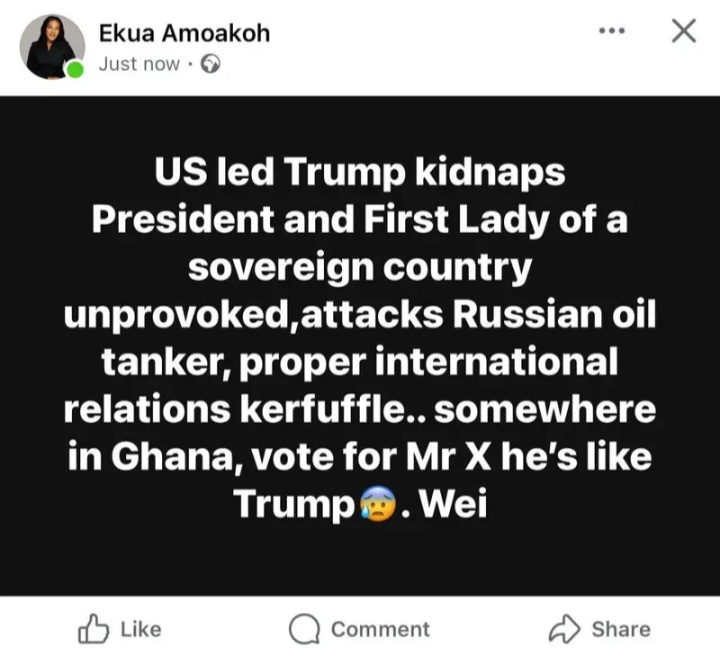
In a public Facebook post, Ekua Amoakoh accused a sitting U.S. president of kidnapping a foreign president and first lady, alleged unprovoked attacks on a Russian oil tanker, and framed these assertions as factual events with international consequences, before tying the narrative to Ghanaian voting choices.
This was not satire. This was not framed as opinion. This was presented as fact.
That distinction is critical.
Kidnapping is not a rhetorical flourish. It is one of the gravest crimes under international law.
To casually deploy such language in a public forum, while holding a senior communications role in a presidential campaign, reveals a disturbing lack of judgment, training, and diplomatic awareness.
Communication at this level is not about emotion or impulse.
It is about restraint, precision, and consequence management. Campaign communications are effectively rehearsals for governance.
They signal how power would be exercised, how crises would be handled, and how Ghana would be represented on the global stage.
What Ekua Amoakoh demonstrated was not boldness. It was immaturity at the highest level of political communication.
No serious communications professional drags foreign governments into Facebook commentary through reckless accusations.
No serious campaign allows a senior spokesperson to create the impression of diplomatic hostility through careless language. And no serious leadership structure treats such behavior as acceptable.
The fallout that followed was predictable and avoidable. When you accuse a foreign government of kidnapping, you invite scrutiny.
You do not get to retreat into victimhood after making an international allegation in a public space. Accountability is not persecution.
More importantly, this incident does not damage political opponents. It damages the credibility of the campaign she represents.
Voters do not separate a deputy director’s words from the candidate’s brand. Campaign teams are judged as extensions of the candidate’s judgment.
When a senior communications official speaks with this level of recklessness, the natural question voters ask is simple and unavoidable:
Who is supervising the message, and is anyone in charge?
This is not about silencing dissent or discouraging passion. It is about competence.
Passion without discipline is noise. Confidence without comprehension is dangerous. In international relations, words have weight.
They shape perceptions, trigger responses, and carry consequences far beyond social media applause.
A presidential campaign that aspires to govern cannot afford this level of carelessness.
If it does, then it signals something far more concerning than a single bad post, it signals a failure of internal standards, oversight, and seriousness.
At this level, mistakes are not just personal. They are institutional.
And when an official entrusted with shaping national messaging demonstrates such poor understanding of diplomacy, international law, and strategic communication, it is not unreasonable for her own team to rethink her role.
Not out of malice. Not out of politics. But out of responsibility.
Because leadership is not tested when things are easy. It is tested by how carefully power is handled, especially in words.
And in this case, the words spoke loudly enough on their own.