
















NPP GERMANY
PRESS RELEASE
02—03—2026
Mahama Now Repackaging 1-District 1-Factory As NDC’s Clueless 24-Hour Economy
Ghana’s political theatre has once again taken center stage, and this time the spotlight is firmly fixed on the National Democratic Congress (NDC) and its much-touted 24-Hour Economy policy.
What was marketed as a transformative, job-creating masterstroke is fast becoming a case study in political repackaging.
For months, Ghanaians have waited for clarity, structure, and measurable rollout plans.
Instead, what they are witnessing appears to be a parade of already existing projects being rebranded as fresh achievements.
The 24-Hour Economy was sold as a bold departure from business as usual — a revolutionary model that would reset Ghana’s productivity engine. Yet, beyond slogans and ceremonial speeches, the policy remains largely conceptual.
Though we now have a legislative framework there has been no detailed funding blueprint laid before Parliament, and no clear sector-by-sector implementation roadmap that citizens can interrogate.
Rather than unveiling new state-backed industrial hubs or fresh manufacturing corridors operating round the clock, the NDC government has chosen a different path — spotlighting factories that were conceived, financed, and commissioned under the New Patriotic Party (NPP)’s One District One Factory (1D1F) initiative.
Take the case of the B5 Plus Steel Plant in Ningo-Prampram.
On April 13, 2021, then-President Nana Akufo-Addo commissioned Phase One of the $80 million facility under the 1D1F policy.
See references here:
https://mobile.ghanaweb.com/GhanaHomePage/NewsArchive/Akufo-Addo-commissions-phase-one-of-the-B5-Plus-Steel-Plant-1231852
https://mobile.ghanaweb.com/GhanaHomePage/business/1-Distrrict-1-Factory-Akufo-Addo-commissions-77m-ceramic-factory-617242
The project was widely recognized as one of West Africa’s largest steel production facilities, strategically positioned to reduce imports and create industrial jobs.
Today, the same plant is being presented in political speeches as a pioneer of the 24-Hour Economy concept.
Yet the factory’s operational structure — including its shift systems — was established long before the NDC’s new policy announcement. It did not suddenly discover night time productivity in 2026.
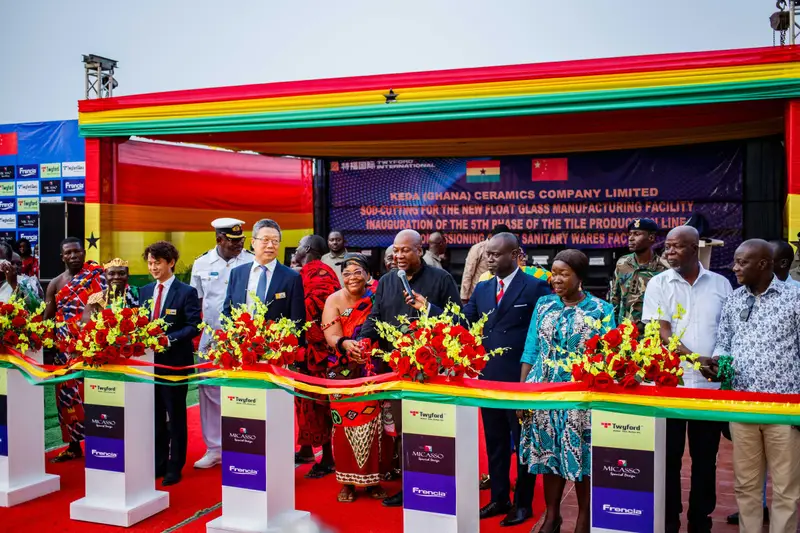
The same pattern emerges in Shama in the Western Region. The KEDA Ceramics factory, operating under the 1D1F umbrella, expanded in phases between 2019 and 2021.
Its third phase was completed in June 2021 after sod-cutting in July 2019 by the previous administration. Thousands of direct and indirect jobs were already attributed to its operations.
At a recent expansion ceremony, KEDA (Ghana) Ceramics publicly reaffirmed alignment with the 24-Hour Economy policy.
The event, graced by President John Dramani Mahama, was portrayed as evidence that the new economic model is gaining traction.
But here lies the uncomfortable question: does endorsement equal origination?
The factory’s 24-hour shift system did not begin in 2026. It has been part of its operational DNA since its earlier commissioning phases under 1D1F.
Praising an existing 24-hour production line does not constitute creating one. Political branding cannot replace policy architecture.
If the 24-Hour Economy is truly a distinct model, where are the new industrial parks designed exclusively around it?
Where are the tax codes tailored specifically to incentivize overnight production across sectors? Where is the regulatory reform to address energy pricing for nocturnal manufacturing?
The NDC’s communication strategy appears heavy on ceremony and light on structural explanation. Sod-cutting events have become symbolic substitutes for systemic transformation. Repainting old buildings does not make them new.
What deepens public skepticism is the absence of fresh capital injection announcements tied directly to the 24-Hour framework.
Instead, expansions financed by private capital or previously secured investments are being folded neatly into the new narrative.
This strategy risks undermining credibility. A transformative economic policy requires more than rhetorical alignment with pre-existing factories.
It requires measurable indicators: how many new 24-hour facilities have been built from scratch under the policy? How many new energy agreements have been negotiated to sustain round-the-clock production at scale?
Ghanaians are not opposed to continuity. In fact, governance continuity is often desirable. But continuity must be acknowledged honestly.
When an administration inherits functioning industrial infrastructure, transparency demands recognition of origin rather than strategic amnesia.
The 1D1F initiative, regardless of political affiliation, established dozens of factories across districts. Some succeeded impressively; others struggled. That debate is legitimate.
However, presenting these same entities as proof of a newly birthed 24-Hour Economy muddies historical fact.
Even more concerning is the absence of sectoral diversity in the 24-Hour conversation.
Beyond manufacturing plants already operating shift systems, what about agriculture logistics, digital services, port operations, or healthcare infrastructure?
A true 24-hour economy is multi-sectoral by design.
Energy supply remains the backbone of any round-the-clock industrial model.
Yet there has been limited public articulation on how the government intends to guarantee uninterrupted, affordable power nationwide to scale such operations.
Without energy reform, the policy risks becoming aspirational rather than executable.
It is also telling that much of the visible momentum attributed to the 24-Hour policy relies on private companies voluntarily aligning themselves rhetorically.
Voluntary alignment is not the same as structured state-led transformation.
President Mahama’s commendation of companies for operating 24-hour shifts may be politically convenient, but it sidesteps the harder task of demonstrating how government intervention directly created those conditions.
Ghana’s electorate is politically sophisticated. Citizens remember timelines. They recall commissioning dates.
They can trace which administration cut sod, secured financing, and supervised construction.
Attempting to compress that history into a new narrative may yield short-term applause but long-term scrutiny.
If the 24-Hour Economy is to survive beyond campaign cycles, it must evolve beyond symbolic association.
Otherwise, it risks being perceived as a rebranding exercise layered atop the industrial skeleton built under the previous administration.
The irony is that the NDC could have chosen a different route: acknowledge the industrial base inherited and build distinctly upon it. Innovation layered upon continuity is more powerful than rhetorical reinvention.
Instead, what is unfolding looks increasingly like political recycling. And recycling, while environmentally commendable, is less inspiring when applied to economic policy narratives.
Ghana deserves clarity, not choreography. It deserves transparent policy frameworks, not photo opportunities.
If the 24-Hour Economy is real, it must be demonstrated in new foundations poured, new factories built, new supply chains engineered — not merely in the renaming of old ones.
Until that distinction becomes visible, the skepticism will persist, and the 24-Hour Economy will remain suspended between promise and perception — struggling not because Ghanaians reject ambition, but because ambition without direction cannot command trust.
This cannot — and must not — be business as usual.
God Bless Our Homeland Ghana!!!
Long Live Ghana, long live the Elephant Party!!!!
Kukruduuuu Eeeessshiii!!!
Signed:
Nana Osei Boateng
NPP GERMANY
Communications Director