
















Ghana’s Financial Intelligence Centre (FIC) has urged investigative journalists across West Africa to sharpen their ability to trace financial transactions, uncover hidden ownership structures and expose the financial trails behind economic and financial crimes.
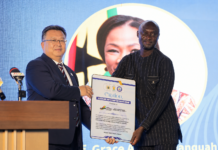
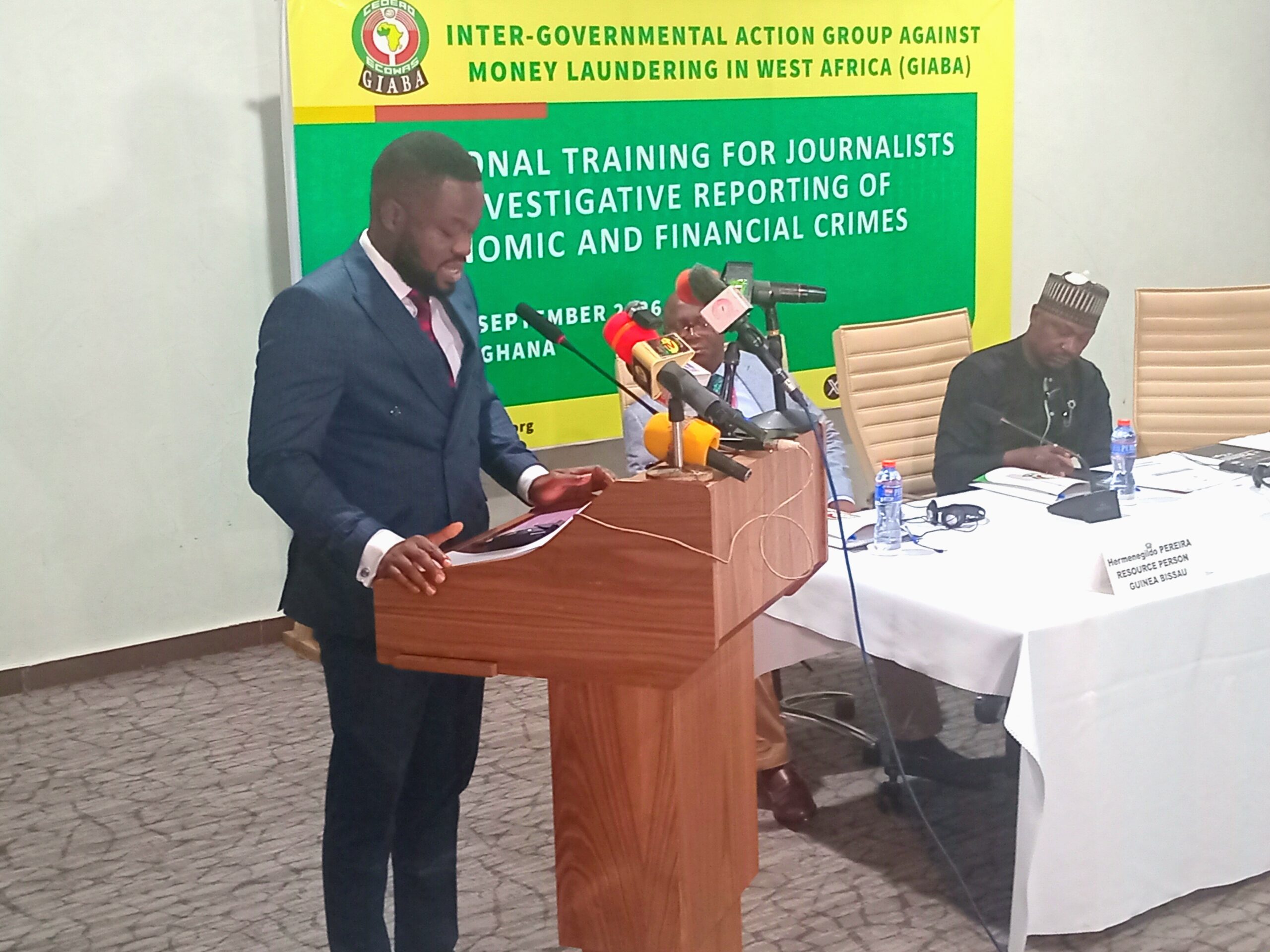
The call was made on Tuesday, September 22, 2026, as the Regional Training Workshop on Investigative Journalism on Economic and Financial Crimes opened at the Palms and Eagles Hotel in Accra.
The three-day workshop, running from September 22 to 24, has brought together representatives of the media and investigative journalism community, GIABA and ECOWAS officials, facilitators and resource persons to strengthen journalists’ capacity to investigate money laundering, terrorist financing and other financial crimes.
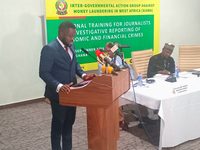
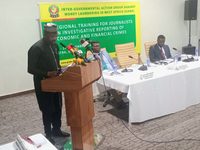
Delivering the welcome address on behalf of the FIC Chief Executive Officer and National Correspondent of GIABA, Mr Albert Kwadwo Twum Boafo, Benjamin Ofori welcomed participants to Ghana and stressed the need for a coordinated approach to combating financial crime.
“This workshop is founded on a simple reality: no single institution can win the fight against economic and financial crime,” he said.
“That fight requires the combined efforts of financial intelligence units, law enforcement agencies, regulators, prosecutors, the judiciary, the private sector, civil society and, importantly, the media.”
Mr Ofori said the media’s involvement in the fight against financial crime was not new, pointing to GIABA’s sustained engagement with investigative journalists since 2010.
“GIABA has long recognised this reality. Since 2010, it has deliberately included the media, particularly investigative journalists, in its stakeholder engagements,” he said.
According to him, the approach reflected the important role journalists play in exposing corruption, challenging impunity and promoting good governance across the region.
“This reflects the important role journalists play in uncovering corruption, challenging impunity and promoting good governance,” Mr Ofori said, adding that similar programmes had been held in Côte d’Ivoire, Benin, Liberia, Cabo Verde, Senegal and Ghana.
He said Ghana was particularly pleased to host the initiative again, recalling that Accra hosted a similar workshop in February 2022, which brought together about 50 journalists and representatives of the Ministry of Information.
“Four years later, its return shows that the partnership between investigative journalism and the fight against financial crime is not a temporary engagement. It requires sustained investment in knowledge, skills, information and professional networks,” he said.
Mr Ofori observed that the changing nature of financial crime had made specialised knowledge increasingly important for journalists, particularly as criminals continued to exploit technology and increasingly complex financial systems.
“Criminals are exploiting technology, digital financial services, complex corporate structures, virtual assets and cross-border transactions,” he said.
He noted that proceeds from fraud, corruption, tax offences, drug trafficking and organised crime could move across several jurisdictions within a short period, while criminals increasingly employed sophisticated methods to conceal the origin, ownership and destination of illicit funds.
Against this background, Mr Ofori said journalists investigating financial crimes must develop the ability to trace the movement of money and understand the structures through which illicit wealth could be concealed.
“The modern financial crime reporter must be able to follow the money,” he stressed.
“This requires an understanding of corporate structures and the ability to examine financial records, identify beneficial owners, analyse procurement information, connect seemingly unrelated transactions and use open-source intelligence.”
He further emphasised that investigative reporting was not simply about obtaining information but also about ensuring that information was properly verified and presented within the context of professional journalism.
“Investigative journalism, however, is not only about finding information. It also requires journalists to verify information, understand its context, protect sources, maintain professional standards and present evidence accurately and responsibly,” he said.
Mr Ofori said the workshop therefore provided an important platform for journalists to deepen their understanding of economic and financial crimes while engaging directly with professionals working within the anti-money laundering and counter-terrorist financing system.
He referred to the 2024 workshop in Cotonou, Benin, which focused on sharpening investigative techniques, developing an investigative culture around money laundering and terrorist financing, and strengthening the network of journalists working in the area.
“Those objectives remain highly relevant today,” he said.
Speaking from the perspective of the FIC, Mr Ofori explained that financial intelligence could become particularly powerful when apparently unrelated pieces of information were brought together and analysed.
“Financial intelligence can reveal patterns that no single transaction shows. A series of apparently unrelated transactions may, when viewed together, expose a network,” he said.
He added: “A company that appears legitimate on paper may conceal a complex ownership arrangement. An ordinary transaction may become significant when considered alongside other information.”
Mr Ofori said journalists had an important role in connecting such information and translating complex financial issues into language that the wider public could understand.
“You connect information, investigate matters of public interest and explain complex financial issues in language the wider public can understand,” he told the participants.
He, however, cautioned journalists to maintain professionalism, accuracy and respect for due process in carrying out their investigative responsibilities.
“Our goal should not simply be to produce more stories about financial crime. It should be to produce well-informed, evidence-based and impactful journalism that explains how financial crime operates, how it affects our communities and economies, and what can be done about it,” he said.
Mr Ofori urged participants to make full use of the expertise available during the three-day programme, encouraging them to ask questions, challenge assumptions, share experiences and establish professional relationships that would extend beyond the workshop.
He also challenged participants to translate the knowledge acquired into practical journalism capable of increasing public awareness of financial crimes.
“Look beyond the workshop itself. Look for the story behind the transaction, the person behind the company, the ownership behind the asset and the financial trail behind the crime. Above all, follow the evidence,” he said.
In his closing remarks, Mr Ofori thanked GIABA for its continued investment in the area and for choosing Ghana as host of the regional initiative once again.
He also assured journalists that institutions within the AML/CFT framework recognised the media’s contribution to transparency, accountability and public understanding of financial crime.
“Your independence and professional responsibility are fundamental,” he said.
“As institutions within the AML/CFT framework, we must provide the institutional mechanisms, the information that the law permits us to share, and the expertise needed to deepen public understanding of financial crime.”
He added: “When we carry out these complementary roles responsibly, society benefits.”
The workshop is expected to strengthen the investigative capacity of participating journalists and deepen collaboration between the media and institutions involved in combating money laundering, terrorist financing and other economic and financial crimes across West Africa.