



















…Open burning banned; workshops, block makers and food joints must control smoke and dust
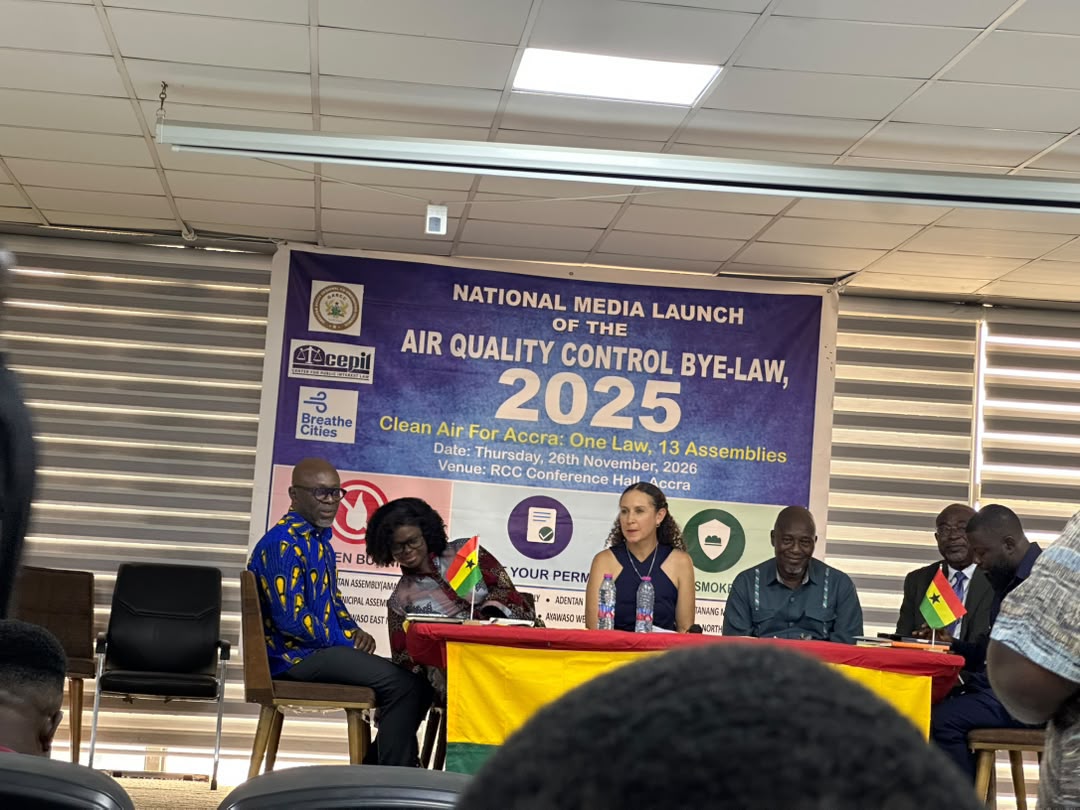
ACCRA, Thursday, 26 November 2026 –Thirteen Metropolitan and Municipal Assemblies in Greater Accra today launched the Air Quality Control Bye-law, 2025, a common set of rules to reduce smoke and dust from open burning and from businesses that pollute the air.
The bye-law was published in the Local Government Bulletin on 2 November 2026 and has the same wording in all 13 Assemblies. The national media launch, held at the Regional Coordinating Council (RCC) Conference Hall in Accra, was organised by the Centre for Public Interest Law (CEPIL) in collaboration with the Greater Accra Regional Coordinating Council, with support from Breathe Cities.
WHAT THE BYE-LAW DOES
Bans open burning. No one may burn any material in the open air without a chimney or other emission control. This covers burning rubbish, tyres and cables and also cooking with firewood unless it is done in an improved or enclosed stove (Sections 7 and 14).
Regulates five activities. Vehicle body works and spraying, carpentry and wood works, metal works and welding, artisanal block making, and commercial food joints must operate in locations approved by the Assembly, away from homes, schools, hospitals, water bodies and wetlands, and must control their emissions (Sections 8 to 12). Spraying must be done in an enclosed booth with an EPA-approved control system and outlets at least 5 metres above roof level. Block yards must be watered to control dust, and food joints must use LPG or improved cookstoves and give off no visible smoke.
Requires permits. Anyone planning a regulated activity needs a business operating permit from the Assembly and an environmental permit from the EPA. The Assembly assesses the activity’s air pollution risk and can attach pollution-control conditions to the permit (Sections 2 to 4).
ENFORCEMENT AND PENALTIES
Each Assembly’s Environmental Health and Sanitation Directorate enforces the bye-law with the EPA (Section 5). Members of the public can report suspected breaches to their Assembly’s Client Service Unit (Section 6).
Breaking the bye-law is an offence. On conviction, offenders face a fine of 100 to 250 penalty units (GH¢1,200 to GH¢3,000), or 30 days to six months in prison, or both, plus up to one penalty unit (GH¢12) for each day a continuing offence goes on, and the full cost of enforcement (Section 13). A food joint that causes a smoke nuisance and ignores an abatement notice must stop operating until an approved plan to reduce the smoke is in place (Section 12).
PUBLIC EDUCATION
Posters, a permit guide and a compliance booklet for businesses are available in English, Twi, Ga and Hausa through the Assemblies. Businesses operating without the required permits are urged to contact their Assembly’s office.
- The 13 Assemblies: Accra Metropolitan Assembly, La-Dade-Kotopon Municipal Assembly, Adentan Municipal Assembly, La Nkwantanang Municipal Assembly, Okaikwei North Municipal Assembly, KorleyKlottey Municipal Assembly, Ayawaso West Municipal Assembly, Ayawaso North Municipal Assembly, Ayawaso East Municipal Assembly, Ayawaso Central Municipal Assembly, Ablekuma North Municipal Assembly, Ablekuma Central Municipal Assembly, Ablekuma West Municipal Assembly.
- Legal reference: Each Assembly has made an identical bye-law, cited as [Assembly name] (Air Quality Control) Bye-law, 2025, for example the Accra Metropolitan Assembly (Air Quality Control) Bye-law, 2025. They were made under section 181 of the Local Governance Act, 2016 (Act 936) and published in the Local Government Bulletin of 2 November 2026. One penalty unit is GH¢12.
- About the Greater Accra Regional Coordinating Council (RCC): The RCC is the Greater Accra region’s coordinating body under the Local Governance Act, 2016 (Act 936). It monitors, coordinates and evaluates the performance of the Metropolitan, Municipal and District Assemblies in the region, and is coordinating the adoption and enforcement of the Air Quality Control Bye-law across the 13 Assemblies.
- About CEPIL: The Centre for Public Interest Law (CEPIL) is a rights-based non-governmental not-for-profit organization based in Accra, Ghana. It was established in 1999 and incorporated under the Companies Code, 2019 (Act 992) as a company limited by guarantee. The Center’s main objective is to make justice accessible and affordable to the poor and marginalized individuals and communities.
CEPIL also uses the law to promote and protect the public interest, including the right to a clean and healthy environment. 5. About Breathe Cities: Breathe Cities is a global initiative of Bloomberg Philanthropies, the Clean Air Fund and C40 Cities that aims to reduce air pollution and carbon emissions in participating cities by 30% by 2030.
Accra is one of its partner cities. Media contact: Dr. Vitus Tankpa, 0201240400, Lastvitus@yahoo.com, Issaka Musah 0207869090, musah.issakabalima@gmail.com ; John Abeku Dennis 0244093133, abeikudennis1984@gmail.com.