























Author: Ebenezer Denzel Amanor || Co-Founder Of CharlieWote.com
I write this open letter to the Ghana National Road Safety Commission out of deep concern for the increasing public controversy surrounding the safety of the Toyota Voxy vehicles on our roads.
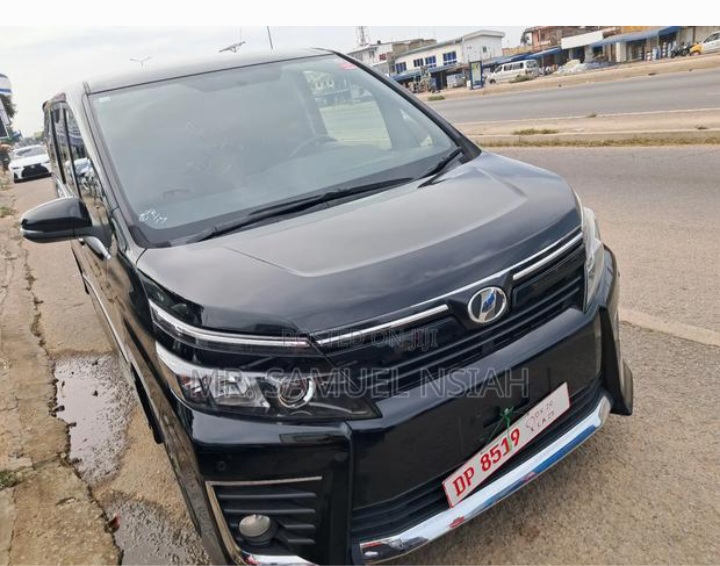
In recent months, the Toyota Voxy has become a popular commercial transport option, yet it has also been unfairly labeled as a “dangerous car.” This narrative, I believe, is misplaced.
As the Co-Founder of CharlieWote.com, a car rental and car-sharing company, I have had direct experience with these vehicles—both operationally and personally.
From this vantage point, I can confidently state that the Toyota Voxy itself is not inherently unsafe. The real issue lies elsewhere.
The Toyota Voxy, manufactured by Toyota Motor Corporation, is engineered with modern safety standards, stability systems, and performance efficiency suited for urban and moderate intercity transportation. Globally, it is regarded as a reliable family minivan, not a high-risk automobile.
Unfortunately, in Ghana, the vehicle’s growing popularity has coincided with a troubling trend: inexperienced drivers taking the wheel without adequate training or discipline.
Many of these drivers are young, newly licensed, and lack the maturity required to manage high-responsibility commercial driving.
The Voxy is a relatively fast and responsive vehicle. When handled properly, this responsiveness enhances safety and comfort.
However, when placed in the hands of drivers who lack defensive driving skills, that same responsiveness becomes a liability.
More alarming is the reported use of stimulant substances by some drivers—locally referred to as “RED.” These substances impair judgment, increase aggression, and create a false sense of control.
A driver under such influence becomes a danger not because of the car, but because of his altered state of mind.
The public must understand this distinction clearly: vehicles do not cause accidents—human behavior does.
Mechanical faults may contribute occasionally, but the overwhelming cause of road crashes is human error, recklessness, and negligence.
Another pressing factor is the “work-and-pay” system under which many of these vehicles are acquired.
Drivers are often placed on long-term lease agreements, creating intense financial pressure to meet daily sales targets.
This pressure pushes many drivers into dangerous habits—overspeeding, wrongful overtaking, skipping rest periods, and overworking the vehicle beyond safe operational limits—all in the name of maximizing daily returns.
The Toyota Voxy was not originally designed as a heavy-duty long-distance commercial bus. It is fundamentally a light multi-purpose vehicle (MPV). Yet in Ghana, it is routinely deployed on demanding routes such as Accra–Kumasi and Accra–Takoradi.
These long-haul routes require vehicles built for endurance, reinforced suspension systems, and heavier structural frames. Subjecting lightweight MPVs to such stress inevitably increases wear and mechanical fatigue.
When a car designed for moderate travel is pushed beyond its engineering limits, the strain can compromise performance. But again, this is not a design flaw—it is misuse.
It is therefore misleading and counterproductive to demonize the Toyota Voxy. Doing so distracts from the root problems: inadequate driver training, weak enforcement of traffic regulations, and economic pressure within the commercial transport sector.
What Ghana truly needs is stricter vetting of commercial drivers before they are allowed to operate high-demand vehicles.
Mandatory defensive driving courses and periodic re-certification should become standard practice.
The authorities must also intensify enforcement against overspeeding.
Speed governors, digital tracking, and stricter penalties for repeat offenders could drastically reduce accident rates.
Additionally, drug testing protocols for commercial drivers should be considered. Road safety is a public health issue as much as it is a transport issue.
Car owners also bear responsibility. Placing profit above safety by pressuring drivers to “make sales” at any cost creates a toxic system that endangers innocent passengers.
The tragic accidents we have witnessed are not caused by “tiny machines,” but by a culture of haste, impatience, and unchecked commercial ambition.
Blaming the car is easier than confronting these uncomfortable truths.
I urge the National Road Safety Commission to redirect public discourse toward behavioral reform, enforcement, and regulatory tightening rather than fueling stigma against a specific vehicle model.
Road safety in Ghana will improve not when we ban popular cars, but when we cultivate responsible drivers, disciplined operators, and accountable vehicle owners. The Toyota Voxy is safe.