




















Author: Fiifi Nettey // Freelance Journalist & Columnist For The Business And Financial Times Newspaper, Ghana West Africa
Participants in Group 2 of the 2026 Belt and Road Journalists Forum had the opportunity to explore Suzhou during a memorable three-day visit. It was a fascinating and enriching experience that offered lasting memories and left a profound impression on me.
From its rich cultural heritage and historical landmarks to its impressive industrial landscape and ambitious development agenda, Suzhou emerged as a remarkable city where tradition and modernity coexist in perfect harmony.
The visit provided valuable insights into how a city can preserve its historical identity, cultural heritage and traditional values while embracing innovation, industrialisation and technological advancement.
A major driving force behind this transformation has been the establishment of the Suzhou Industrial Park (SIP), which has significantly reshaped the city’s economic landscape and redefined its development progress. Over the years, the park has evolved into a major hub for technological innovation, attracting leading technology companies, promoting industrial growth and creating thousands of employment opportunities for both local residents and international professionals.
Suzhou success demonstrates how strategic planning, investment and international cooperation can transform a city’s economic fortunes and move into development.
One of the memorable moments of the visit was an unforgettable trip to the Lion Grove Garden (Shizilin), one of Suzhou’s four most celebrated classical gardens and regarded as the finest surviving example of a garden from the Yuan Dynasty in the Jiangnan region.
The garden is particularly renowned for its spectacular and intricate rockery, a fascinating maze of caves, towering stone peaks and winding pathways crafted from Taihu limestone. Exploring this extraordinary landscape felt like stepping into another world, where nature, art and traditional Chinese garden design come together in remarkable harmony.
The Lion Grove Garden was originally constructed in 1352 and was later renamed Bodhi Orthodox Temple. During the transition between the late Yuan and early Ming dynasties, it became the residence of Pan Yuanshao, the son-in-law of Zhang Shicheng. In the early Hongwu era of the Ming Dynasty, the garden was incorporated into Chengtian Nengren Temple.
In 1953, the Suzhou Cultural Relics Management Committee assumed responsibility for the garden. It was subsequently transferred to the Garden Management Office and officially opened to the public in 1954. Recognising its outstanding historical and cultural significance, Lion Grove Garden was engraved on the UNESCO World Heritage List in 2000 and designated a Major Historical and Cultural Site Protected at the National Level in 2006.
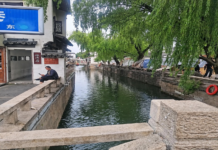
Another wonderful place we visited was the The Pingjiang Historical and Cultural Block is the most complete, best-preserved, and largest historical neighborhood in Suzhou. It is located in the northeast of the old city, this 116.5-hectare area has a history spanning more than 2,500 years and is often described as “a Jiangnan cultural museum without walls” — a living collection of heritage that has never been sealed off from daily life.
The block still maintains the “water and land parallel, river and street adjacent” double-grid layout that was first laid out in the Song Dynasty.
The Southern Song Pingjiang Map, the oldest surviving stone-carved city map in China, depicts this exact configuration — and walking through the block today, the correspondence between the map and the streets is still immediately recognizable. The main street, Pingjiang Road, runs for 1,606 meters alongside the Pingjiang River, with 13 ancient stone bridges crossing the water and more than 20 lanes branching off to the east and west.
This continuity is not accidental. Since 1986, when the block was designated an absolute protection zone in Suzhou’s master plan, four successive rounds of urban planning have upheld three principles: the overall layout remains unchanged, the skyline is capped at 24 meters, and building colors are restricted to black, white, and gray.
There is one UNESCO World Cultural Heritage site — the Couple’s Retreat Garden,(Asia- Pacific World Heritage Training and Research Centre), the China Kunqu Opera, Museum, dedicated exhibition venue for Kunqu Opera, recognized by UNESCO as masterpiece of the Oral and Intangible Heritage of Humanity and more than 100 cultural heritage sites protected at the provincial or municipal level. More than 100 elements of the historic urban landscape including city walls, waterways, beidges lanes traditional acient wells old trees and ceremonial archways have retained their original appearance
These heritage sites are beautifully preserved, offering an atmosphere of tranquillity and serenity while reflecting China’s deep appreciation for nature and cultural heritage. They provide visitors with lasting memories, bringing history to life through the preservation of traditional practices, architectural elegance and cultural values. I was fascinated by the level of preservation and immediately Ghana came to mind. We need to understudy how Suzhou have been able to turn these heritage sites into tourist attraction with wonderful historical and preserved culture.
Suzhou stands as a shining example of how cultural heritage preservation and modern development can complement each other, creating opportunities for sustainable growth, economic transformation and social progress. Its development journey offers valuable lessons for cities and countries across the Global South and Africa, on the importance of balancing cultural preservation with modernisation to improve the living conditions of its citizens.
We were delighted that the organisers of the Belt and Road Journalists Forum 2026 provided us with the opportunity to explore Suzhou’s remarkable historical heritage and gain deeper insights into the rich culture and traditions of the Chinese people. Our visit revealed that Suzhou is much more than its impressive industrial parks and modern economic landscape.
The city is also home to fascinating historical sites, cultural treasures and memorable tourist attractions that reflect its rich history and enduring heritage. It is a remarkable destination where history, culture, tourism and modern development coexist in harmony and it is creating employment for its citizens.
The opening ceremony of the 2026 Belt and Road Journalists Forum was held on October 17, 2026, at Nanjing Hall, International Youth Convention Hotel, in Nanjing, Jiangsu Province, China, bringing together participants from different parts of the world. It was a memorable and insightful occasion that provided a platform for discussions on the remarkable development taking place across the Global South, with China playing an increasingly influential role in promoting cooperation, connectivity, innovation and shared development.