





















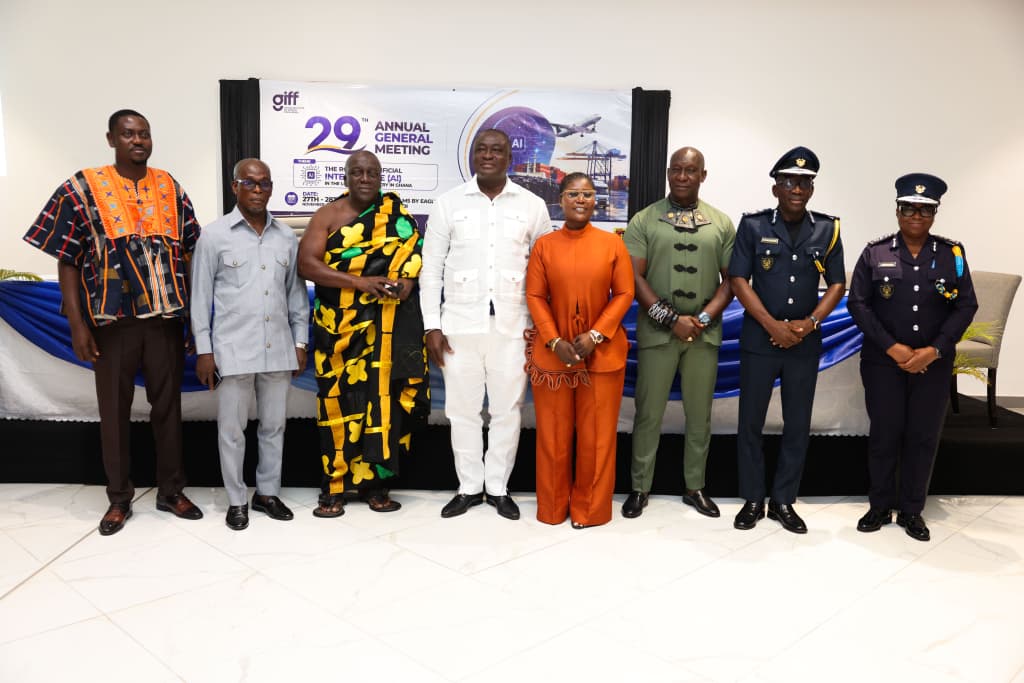
The Ghana Institute of Freight Forwarders (GIFF) has held its 29th Annual General Meeting (AGM) in Takoradi, bringing together government officials, industry regulators, freight forwarders and other logistics stakeholders to deliberate on the future of the industry under the theme: “The Role of Artificial Intelligence (AI) in the Logistics Industry in Ghana”.
The event attracted high-level participation from key public and private sector institutions involved in trade facilitation and logistics management.
The Commissioner of the Customs Division of the Ghana Revenue Authority, Mr Aaron Kanor, chaired the AGM, while the Omanhene of the Essikado Traditional Area in Sekondi, Nana Kobina Nketsia V, welcomed participants and commended freight forwarders for their significant contribution to trade facilitation and national development.
The Deputy Minister of Transport, Ms Dorcas Affo-Toffey, delivered the keynote address on behalf of the Minister of Transport, Mr Joseph Bukari Nikpe, who stressed the need for Ghana’s logistics industry to embrace artificial intelligence to improve efficiency, transparency and competitiveness.
The Minister said Ghana’s strategic location, deep-water ports, expanding aviation infrastructure and its status as host of the African Continental Free Trade Area (AfCFTA) Secretariat presented a unique opportunity for the country to emerge as the preferred trade gateway in the West African sub-region.
He, however, noted that achieving that ambition would require more than investment in physical infrastructure.
“Our ports remain a vital lifeline for our landlocked neighbours, particularly Burkina Faso, Mali and Niger,” the Minister said, adding that shippers increasingly chose trade corridors based on reliability, speed, cost efficiency and service quality rather than port capacity alone.
To strengthen Ghana’s competitiveness, he advocated the deployment of AI-powered systems across the logistics value chain, including predictive cargo management, intelligent port operations, automated customs processes, transport and fleet management, supply chain visibility and data-driven decision-making.
He explained that AI could help anticipate cargo volumes and port congestion, improve cargo evacuation, strengthen customs risk management and provide real-time visibility across supply chains, thereby making trade processes faster and more efficient.
The Minister further observed that the future competitiveness of Ghana’s ports would depend increasingly on intelligence, integration and operational efficiency rather than physical infrastructure alone.
He, therefore, called for greater interoperability among port community systems, customs platforms, shipping lines and terminal operators to establish a seamless digital trade ecosystem.
The President of GIFF and Vice-President of the International Federation of Freight Forwarders Associations (FIATA), Mr Stephen Adjokatcher, described the theme as a deliberate response to the changing dynamics of global trade and logistics.
He said freight forwarders needed to embrace innovation to remain relevant in an increasingly technology-driven business environment.
He highlighted several challenges confronting the industry, including congestion within the Tema Port enclave, operational inefficiencies involving shipping lines, difficulties arising from the implementation of the Publican AI valuation system and disruptions to transit trade at Ghana’s land borders.
Mr Adjokatcher said GIFF had actively engaged the government and other stakeholders on port congestion and submitted proposals aimed at improving cargo evacuation and operational efficiency.
He also announced plans to accelerate the institute’s digital transformation agenda through the introduction of a Management Information System (MIS) in partnership with CAS Broker.
The initiative is expected to improve membership management, professional certification and communication, while providing a platform for the future integration of AI-driven services.
Solidarity messages were delivered by representatives of the Ghana Ports and Harbours Authority (GPHA), Ghana Shippers’ Authority, Ghana Maritime Authority, Ghana Link Network Services, Customs Brokers Association of Ghana (CUBAG) and the Association of Customs House Agents Ghana (ACHAG).
The institutions reaffirmed their commitment to supporting the development of a competitive logistics industry.
They also acknowledged the significant opportunities artificial intelligence offered for improving cargo management, customs processes, supply chain visibility and operational efficiency, while stressing the importance of appropriate oversight, transparency and stakeholder engagement in its deployment.