



















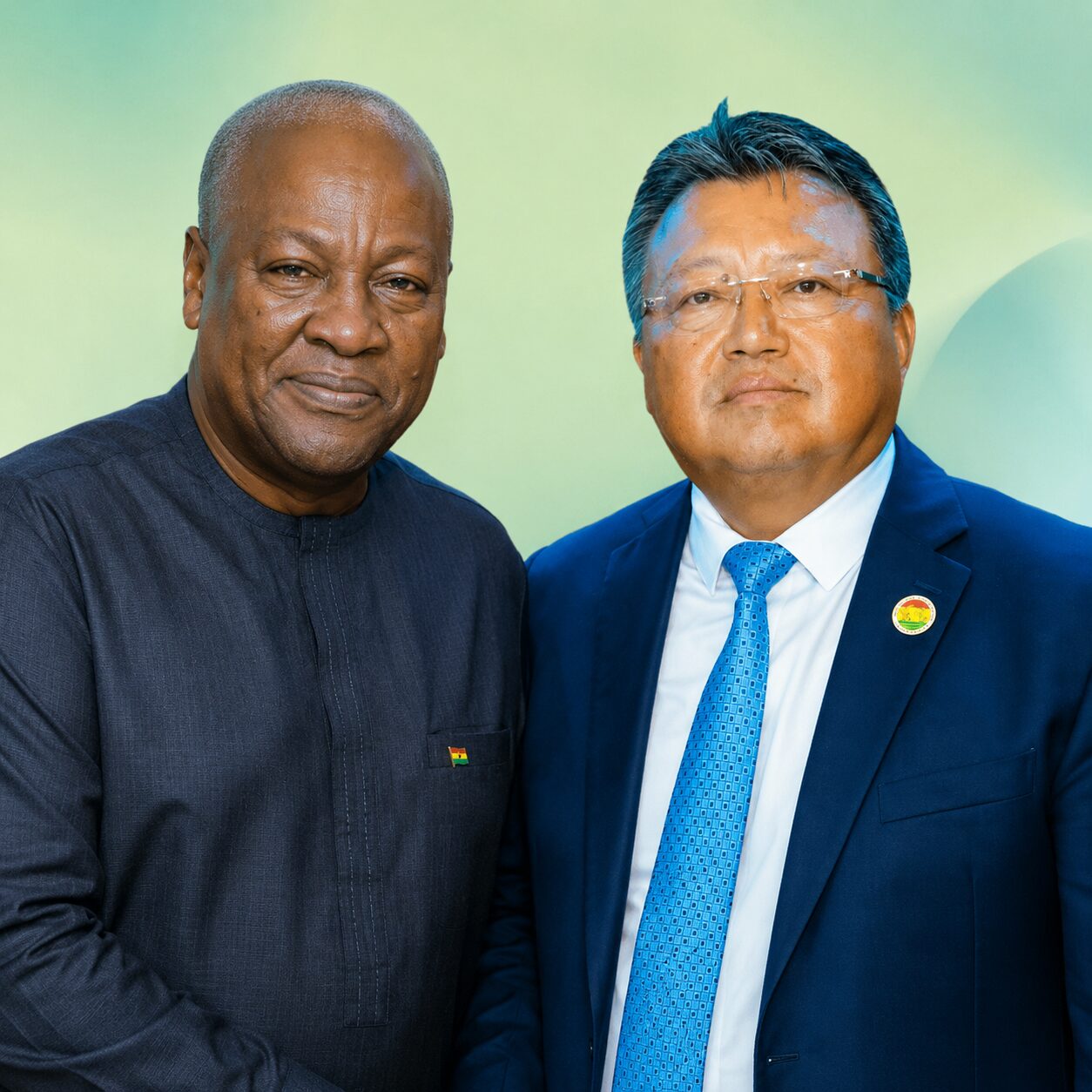
President John Mahama and CAITECH Chairman Mr. Tang Hong
Writer: Investigative Journalist Daniel Benin Ohim
As a result of an on-the-ground investigation by AmaGhana Online investigative journalist Daniel Benin, the journist has dragged the Weija Gbawe Municipal Assembly into the illegal landfill site that has been attributed to the cause of flooding at Mallam.
The recurring flooding at Mallam, is a problem many residents have attributed to poor waste management and the dumping site that has blocked drainage systems hindering the passing of rain storm water.
It was not surprising that when contacted, the Weija Gbawe Municipal Assembly admitted that the illegal landfill site at Mallam was a major contributor to the flooding that struck the community following the heavy rains on Monday, June 29.
The Assembly further alleged that the site originated from the Weija Gbawe Assembly under a contract approved during the tenure of a former Municipal Chief Executive (MCE) under the previous New Patriotic Party (NPP) administration. It claimed that documents bearing the former MCE’s signature support this assertion, although the former MCE reportedly denied that the signature was his when confronted.
The Assembly also alleged that waste disposal activities at the site obstructed the natural flow of stormwater through the drainage system, contributing to the flooding experienced in Mallam and neighbouring communities.
Investigations further suggest that repeated efforts to bring Assembly engineers and other stakeholders together with CAITECH to discuss a permanent solution have yielded no progress under both previous and current administrations.
However, during an exclusive interview with AmaGhana Online, the Chairman of CAITECH, Mr. Tang Hong, said he is prepared to sacrifice so that poor residents who suffer at the receiving end of these disasters will have their peace
“I am prepared to finance, provide logistics and equipment to stop this problem once and permanently,” Mr Tang assured.
However, he stressed that success will depend on the willingness of the Weija Gbawe Municipal Assembly (WGMA) and other relevant government authorities to collaborate.
According to Mr. Tang, previous attempts by CAITECH to work with the Municipal Assembly and other stakeholders did not receive the necessary commitment to permanently resolve the problem.
He has therefore invited the Weija Gbawe Municipal Assembly, President John Dramani Mahama, and all relevant government agencies to engage with CAITECH on a lasting solution.
Mr. Tang said CAITECH is prepared to fund the entire operation, including logistics, equipment, dredging works, and, if necessary, the relocation of the landfill site.
He believes that clearing the solid waste blocking the drainage channels will significantly reduce the flooding that regularly affects Mallam Junction and surrounding communities.
Investigations by AmaGhana Online further suggest that during the more than 30 years CAITECH has operated in Mallam, flooding was not as severe until additional parcels of land in the area were allocated to other companies, whose activities, according to Mr. Tang, have worsened the situation.
He alleged that every attempt by CAITECH to collaborate with other companies operating in the area, as well as the Municipal Assembly, to resolve the waste disposal challenge has been met with limited commitment.
Mr. Tang also noted that CAITECH is not the only company operating around Mallam Junction. He mentioned that VVIP Transport Group also operates a service facility in the area but claimed that responsibility for addressing environmental challenges often falls disproportionately on CAITECH.
He reiterated that his only request is for government authorities to engage with the company, grant the necessary permits, and work together towards implementing a permanent solution to the flooding crisis.
Assembly Links Illegal Landfill to Flooding
Despite these concerns, Mr. Tang commended the current Municipal Chief Executive for efforts made so far and appealed to him to urgently engage with CAITECH to find a lasting solution.
“We are ready to do whatever it takes,” Mr. Tang said. “We only need the government and the Assembly to sit with us so we can permanently solve this problem.”
Residents Continue to Pay the Price
The flooding that engulfed Mallam, Gbawe and adjoining communities after Monday’s rains was not simply the result of heavy rainfall.
While the downpour triggered the disaster, residents and environmental observers argue that years of poor urban planning, weak enforcement of waste management regulations and blocked drainage systems created the conditions that turned heavy rain into a humanitarian emergency.
At the centre of the crisis is the illegal landfill site, which residents say has for years contributed to choking the community’s main drainage channels with refuse, plastic waste and silt.
As these drains lose their capacity to carry stormwater, floodwaters spill into homes, businesses and major roads, leaving residents to bear the consequences.
Community members, civil society organisations and environmental experts have repeatedly raised concerns over the situation. Yet, critics argue that official responses have largely been limited to emergency desilting exercises after flooding has already occurred, rather than implementing permanent preventive measures.
This recurring pattern has become familiar. Following every major flood, officials visit affected communities, announce investigations, establish task forces and promise lasting solutions. However, many residents say little changes before the next rainy season.
Flooding around Mallam Junction, the Kasoa-Mallam Highway and surrounding communities has become so predictable that residents can often identify which roads will become impassable after heavy rainfall.
Families living around the Mallam area and nearby communities continue to face repeated evacuations, while businesses suffer significant financial losses and emergency responders are repeatedly called upon to conduct rescue operations that many believe could have been prevented.
Call for Decisive Leadership
The continued existence of an illegal landfill site in a densely populated urban community raises serious concerns about regulatory enforcement and environmental governance.
If blocked drainage systems caused by poor waste management are widely acknowledged as major contributors to flooding, many residents ask why decisive action against illegal dumping has remained slow.
Government has taken steps to improve regulated waste management facilities, including efforts to strengthen operations at the Mallam Transfer Station. Those initiatives have been welcomed by stakeholders. However, many believe their impact will remain limited if illegal dumping activities continue unchecked.
The consequences of inaction extend far beyond damaged property. Floodwaters destroy livelihoods, spread disease, disrupt transportation, interrupt commercial activity and place enormous pressure on emergency services. Ghana’s history has repeatedly demonstrated that delayed intervention can also result in tragic loss of life.
Leadership is measured not only by responses after disasters but by the ability to prevent disasters before they occur.
Many stakeholders are therefore calling for a comprehensive flood prevention strategy for Greater Accra that goes beyond annual clean-up exercises.
Such a strategy should include the permanent closure of illegal landfill sites, reconstruction of damaged drainage systems where necessary, strict enforcement of waste management laws, and meaningful sanctions against individuals or organisations that obstruct waterways.
Urban planning should not be compromised by weak enforcement or political considerations. Every blocked drain, every illegal structure and every unauthorised landfill increases the risk of another flood disaster.
For the people of Mallam, recurring floods have become more than a seasonal inconvenience. They represent a persistent public safety challenge that demands immediate, coordinated and sustained action.
Residents hope that the latest call by CAITECH for collaboration with government authorities will finally result in the permanent solution that the community has sought for many years.
Should the illegal landfill continue to obstruct the drainage system without decisive intervention, future flooding will increasingly be viewed not simply as a natural disaster, but as a preventable tragedy shaped by years of inaction.
We urge our followers to stay on the site for other sides of this problem that if not checked can further complicate the environmental sanitation issues at Mallam in Accra.