

















Author: Opanyin Abrampah Oppong
The growing public anxiety over the future of the Volta Aluminium Company (VALCO) should concern every patriotic Ghanaian. Whether the reports prove accurate or not, the mere suggestion that one of the country’s most strategic industrial assets could be transferred into private hands demands immediate public scrutiny and transparent answers from those in authority.
VALCO is not just another state-owned enterprise. It represents decades of Ghana’s industrial aspirations and forms a critical link in the nation’s aluminium value chain. Decisions affecting its future should never be shrouded in secrecy or speculation.
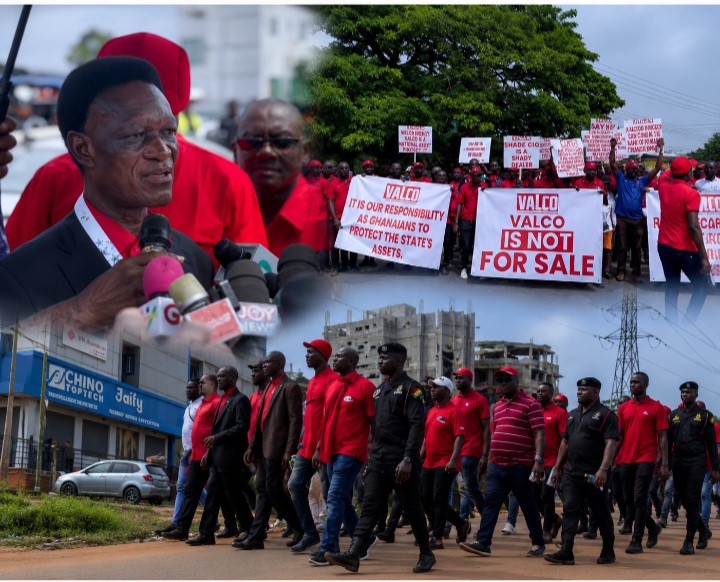
The scenes witnessed in Tema, where angry youth took to the streets dressed in red and black to protest the reported plans, reflect more than political dissatisfaction. They reveal a deep fear that national assets painstakingly built over generations could gradually slip beyond the control of the Ghanaian people.
The concerns have since been echoed by VALCO workers themselves. Together with their union leaders, they presented a petition to the Mayor of Tema, Hon. Ebi Bright, appealing for intervention to safeguard both the company and the livelihoods of its employees. Their actions demonstrate that those closest to the company believe their concerns deserve serious attention.
https://www.facebook.com/share/v/1JgWbUCVBq
https://www.facebook.com/share/r/1PraWWG6mH
Public debate intensified after political commentary questioned whether the government intended to introduce a strategic partner into VALCO and whether such an arrangement could leave Ghana with reduced ownership. These questions deserve clear and factual responses from the government rather than prolonged uncertainty.
Rumours and allegations circulating in the public domain have also linked prominent individuals to the reported plans.
Unless supported by evidence and officially confirmed, such claims should be treated with caution. At the same time, government silence can allow speculation to flourish, making timely communication all the more important.
History teaches painful lessons. Ghanaians have witnessed state enterprises decline through poor management, controversial transactions and inadequate public accountability. Those experiences explain why many citizens now react swiftly whenever questions arise about the future of major national assets.
The slogan “Create, Loot and Share” has long been used in Ghanaian political discourse to criticize alleged misuse or transfer of public resources for private benefit. Whether or not that description applies in this instance, citizens are justified in demanding that any proposal involving VALCO be subjected to full public disclosure and rigorous oversight.
If there are genuine plans to restructure VALCO, the government owes Ghanaians a comprehensive explanation. Citizens deserve to know who the proposed partners are, the terms of any agreement, the expected benefits, the risks involved and how Ghana’s long-term interests will be protected.
Transparency is not an obstacle to development; it is a prerequisite for public trust. Strategic investments can succeed only when they are openly explained, independently assessed and subjected to democratic accountability.
The workers’ petition serves as a reminder that industrial policy is ultimately about people. Behind every decision are thousands of jobs, families, suppliers and communities whose futures depend on the continued success of the company.
Parliament, organized labour, civil society organizations and industry experts should all play active roles in examining any proposal that could alter the ownership or governance structure of VALCO. Such decisions should never be made without broad consultation and public accountability.
Ghana’s natural resources and strategic industries belong to the people. Governments are entrusted to manage them responsibly and in the national interest, not merely for the duration of a political administration.
This moment calls for vigilance rather than complacency. Citizens should continue to demand facts instead of rumours, transparency instead of secrecy, and accountability instead of uncertainty. Protecting national assets is a collective responsibility that transcends partisan politics.
Until the government provides a definitive account of its intentions regarding VALCO, public concern is likely to persist.
The surest way to dispel speculation is through openness. Whatever the future holds for VALCO, it must be guided by the overriding principle that Ghana’s strategic national assets should be managed in a manner that serves the enduring interests of all Ghanaians—not a privileged few.