
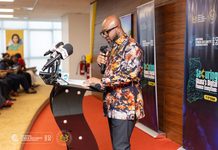
















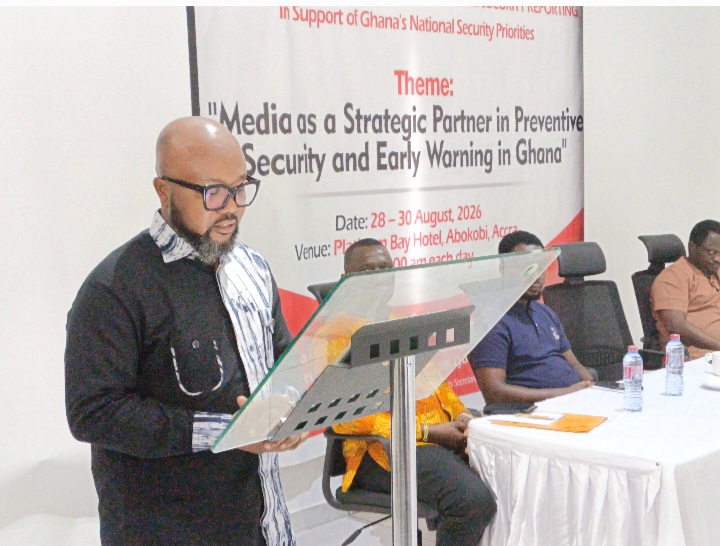
The Director-General of the Cyber Security Authority (CSA), Divine Selase Agbeti, has charged members of the Private Newspapers and Online News Publishers Association of Ghana (PRINPAG) to see themselves as frontline defenders of Ghana’s peace, stressing that national security can no longer be left to uniformed agencies alone.
He said the changing nature of threats, from cybercrime to disinformation and communal conflicts, has placed the media at the centre of national resilience.
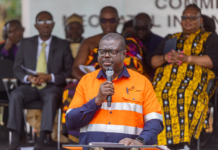
Delivering his closing remarks at the end of a two-day Capacity Building Workshop on Responsive National Security Reporting for PRINPAG members in Accra, Mr. Agbeti said the workshop was deliberately designed to expose journalists to the full spectrum of Ghana’s security landscape.
He disclosed that over the past two days, participants examined the national security architecture, emerging asymmetric threats, communal conflicts, strategic communication, legal frameworks, cybercrime, information warfare, ethics, press freedom and national interest.
“These are not separate observations. Together they define the environment in which the Ghanaian media must now operate,” Mr. Agbeti stated.
He said the central takeaway from the intensive engagement was clear and non-negotiable.
“The central message of this workshop is simple. National security is not the exclusive responsibility of the security agencies. It is a shared national duty and the media is a strategic partner,” he declared.
According to him, the media’s role as a strategic partner does not mean losing its watchdog role or becoming a mouthpiece for government.
“That partnership does not require the media to surrender its independence, suppress legitimate criticism or become an extension of government,” he stressed.
He explained that a strong, independent press rather strengthens national security when it operates professionally and responsibly.
“On the contrary, a professional, independent and courageous press strengthens national security by exposing wrongdoing, countering falsehoods, informing the public and holding institutions accountable. But freedom carries responsibility,” he stated.
Mr. Agbeti warned that Ghana is now operating in a highly volatile information environment where a single piece of false content can cause nationwide panic.
“In a volatile information environment, accuracy, context and judgement are instruments of national resilience,” he noted.
He cautioned journalists about the far-reaching consequences of unverified and sensational reporting.
“A misleading headline can spread across the country in minutes. An unverified video can trigger fear, inflame communal tensions or damage public confidence. A report that reveals sensitive operational details can compromise an investigation and put lives or critical systems at risk,” he warned.
But he was quick to add that responsible journalism has the opposite, powerful effect.
“Conversely, one carefully verified report can stop misinformation, protect the public and help institutions respond effectively,” Mr. Agbeti said.
Touching on cyber threats, the CSA boss revealed that cybercriminals and hostile actors now exploit urgency, fear and public trust as weapons.
He said tactics such as impersonation, compromised accounts, manipulated images, synthetic audio and coordinated disinformation are being used to deceive citizens.
“Journalists and newsrooms are both targets and potential force multipliers. When a journalist’s account is compromised the attacker gains access not only to data but also to credibility and an audience,” he cautioned.
To counter this, Mr. Agbeti urged every newsroom in the country to make cyber security part of its editorial culture, not just an IT issue.
He listed basic safeguards including strong unique passwords, multifactor authentication, prompt software updates, secure backups, verification of links and attachments, clear access controls and an incident response plan.
“So imagine if the media themselves have this practice then it is easy to educate those out there,” he added.
He concluded that the partnership between national security and the media must be built on mutual respect, continuous training and shared responsibility to protect Ghana’s democracy and stability.
The two-day workshop, which brought together journalists from across the country, ended with a call for sustained collaboration between PRINPAG, the CSA and the National Security Council.