


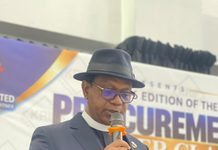










Chairman of Friends of Bawumia (FoB 08), Lawyer Charles Owusu Juanah has condemned the arrest and ongoing prosecution of NPP Bono regional Chairman Kwame Baffoe, aka Abronye DC and recently, Mahama Aminat, popularly known as “Bawumia Ba,” describing it as criminalization of free speech and attack on our democracy.
According to him Ghana has come too far in democratic development to descend into an era where citizens are arrested, intimidated, and detained merely because they expressed political opinions or criticized public officials.
Lawyer Owusu Juanah made the statement at a news conference in Accra on Tuesday May 26, 2026.
“The ongoing prosecution and detention of Mr. Kwame Baffoe, popularly known as Abronye DC, raises serious constitutional and democratic concerns that every freedom-loving Ghanaian must speak against. Reports indicate that he has been charged with offensive conduct and publication of false news over comments allegedly made concerning a judge. (Ghana News Agency)
PRESS CONFERENCE BY CHARLES OWUSU JUANAH ESQ. : SENIOR CITIZEN, LEGAL PRACTITIONER & CONCERNED DEMOCRAT
ON THE DANGEROUS CRIMINALIZATION OF FREE SPEECH AND NATIONAL POLICY MISPRIORITIZATION IN GHANA
Ladies and Gentlemen of the Media,
Fellow Ghanaians,
Distinguished Members of the Legal Fraternity,
Defenders of Democracy and Human Rights,
Good afternoon.
I address you today with a heavy heart but with an unshaken commitment to constitutional democracy, the rule of law, and the sacred liberties guaranteed under the 1992 Constitution of the Republic of Ghana.
Ghana has come too far in democratic development to descend into an era where citizens are arrested, intimidated, and detained merely because they expressed political opinions or criticized public officials.
The ongoing prosecution and detention of Mr. Kwame Baffoe, popularly known as Abronye DC, raises serious constitutional and democratic concerns that every freedom-loving Ghanaian must speak against. Reports indicate that he has been charged with offensive conduct and publication of false news over comments allegedly made concerning a judge. (Ghana News Agency)
This development cannot be viewed in isolation, as similar concerns have emerged in recent months involving the arrest, detention, or prosecution of several social media commentators and politically aligned activists, including Sir-Obama Pokuase, Fante Comedy and AY (TikTok creators), and other unnamed communicators linked to political commentary online.
More recently, Mahama Aminat, popularly known as “Bawumia Ba,” was arrested and granted bail over alleged social media content described by authorities as threatening or inciting against the President, further intensifying national debate on the boundaries between free expression and criminal liability.
Let me state clearly:
Freedom of speech is not a gift from government. It is a constitutional right.
Article 21(1)(a) of the 1992 Constitution guarantees:
“Freedom of speech and expression, which shall include freedom of the press and other media.”
Article 162 further guarantees media freedom and expressly prohibits censorship and interference by government.
The framers of our Constitution understood one fundamental principle: democracy dies when citizens become afraid to speak.
This is precisely why Ghana repealed the Criminal Libel Law through the Criminal Code (Repeal of Criminal Libel and Seditious Laws) Amendment Act, 2001 (Act 602).
The repeal of the criminal libel law was one of the greatest democratic milestones in our Fourth Republic. It was intended to ensure that political criticism, public commentary, and dissent would not be criminalized by governments seeking to silence opponents.
No democratic government that genuinely believes in constitutionalism should attempt to indirectly resurrect criminal libel through selective prosecutions, intimidation, and politically motivated arrests.
The Constitution is supreme under Article 1(2), and any law inconsistent with it is void to the extent of the inconsistency.
The Constitution recognizes civil remedies for reputational injury. If a person believes his or her reputation has been damaged, the courts are available for civil action. Democracy does not thrive through arrests and intimidation.
The Supreme Court of Ghana has consistently defended constitutional liberties.
In New Patriotic Party v. Inspector-General of Police [1993-94] 2 GLR 459, the Supreme Court affirmed that constitutional freedoms cannot be suppressed through administrative or executive intimidation.
Likewise, in Tommy Thompson Books Ltd. v. State, the courts reinforced the principle that freedom of expression remains a cornerstone of democratic governance.
Globally, the legal position is even clearer.
Article 19 of the Universal Declaration of Human Rights states:
“Everyone has the right to freedom of opinion and expression.”
Article 19 of the International Covenant on Civil and Political Rights (ICCPR), to which Ghana is a signatory, equally protects political expression and public criticism.
Article 9 of the African Charter on Human and Peoples’ Rights guarantees every individual the right to receive information and express opinions within the law.
Across democratic jurisdictions including the United States, the United Kingdom, South Africa, and India, courts have repeatedly held that public officials must tolerate higher levels of criticism because they exercise public power.
Public office does not grant immunity from criticism.
Indeed, democracy requires scrutiny of judges, ministers, presidents, police officers, and state institutions.
What we are witnessing today under the administration of President John Dramani Mahama is a dangerous pattern that threatens the democratic gains of our Republic.
The arrest and public controversies surrounding figures such as Oliver Barker-Vormawor, as well as the broader Ejura-related tensions involving the late Macho Kaaka (Ibrahim Mohammed), further demonstrate how politically sensitive speech and activism have repeatedly intersected with state security responses in recent years.
Ghanaians did not fight military dictatorship, political intimidation, and authoritarianism only to return to a culture of fear under constitutional rule.
No President must govern Ghana as though criticism is a criminal offence.
No government should weaponize state institutions against political opponents.
No democracy survives when citizens begin to whisper instead of speak freely.
I wish to advise officers within the police service, intelligence agencies, and other state institutions to exercise extreme caution when carrying out politically sensitive directives.
The Constitution protects lawful conduct : not unlawful obedience.
If a police officer unlawfully arrests, brutalizes, or violates the constitutional rights of a citizen under political instructions, that officer may personally face civil and criminal liability in the future.
“Following orders” has never been an absolute legal defence under constitutional jurisprudence.
Governments change. Political power changes hands. But unlawful conduct leaves permanent legal consequences.
State officers must therefore remember that their primary oath is to the Constitution of Ghana : not to a political party, not to a sitting President, and not to any temporary government.
History has shown across the world that public officers who abuse power under political influence often face legal accountability after regime changes.
This happened after apartheid in South Africa.
It happened in Latin American dictatorships.
It happened after military regimes in Africa.
And it can happen anywhere constitutional violations occur.
The safest protection for every officer is professionalism, neutrality, and fidelity to the Constitution.
Let me be unequivocal:
This nation belongs to the people of Ghana : not to any government.
President Mahama must understand clearly that Ghanaians will not accept intimidation, selective justice, suppression of dissent, and political victimization disguised as law enforcement.
We have matured as a democracy.
We have suffered too much as a nation to return to the dark days where citizens fear arrest for expressing opinions.
The strength of a democracy is measured not by how it treats praise, but by how it tolerates criticism.
Today it may be Abronye DC.
Tomorrow it could be a journalist.
The next day, an activist.
Then eventually, the ordinary Ghanaian.
This is why all defenders of democracy, irrespective of political affiliation, must speak against the dangerous criminalization of free speech.
I call upon:
- The Ghana Bar Association,
- Civil society organizations,
- The media,
- Religious bodies,
- Human rights advocates,
- And all patriotic citizens,
to rise and defend the Constitution before fear replaces freedom.
Ghana must never become a Republic where political disagreement becomes a criminal offence.
Ghana must never become a Republic where political disagreement becomes a criminal offence, or where economic ambition replaces the right to life and health.
Long live constitutional democracy.
Long live freedom of speech.
Long live the Republic of Ghana.
Thank you.
Charles Owusu Juanah Esq.
Senior Citizen & Legal Practitioner