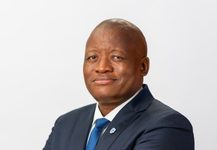




















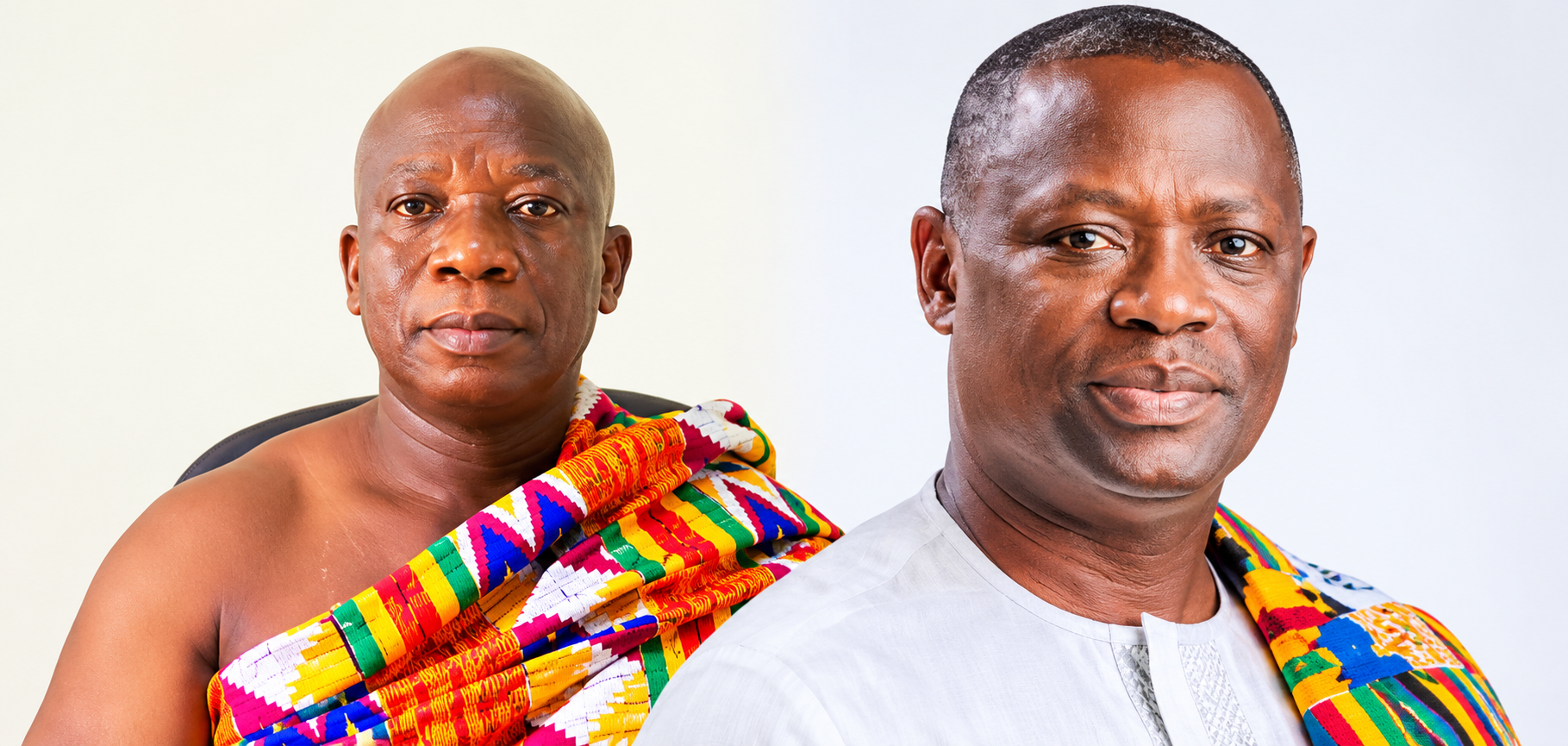
Minister for Lands and Natural Resources and Member of Parliament for Ellembelle, Hon. Emmanuel Armah Kofi Buah has been accused by Eastern Nzema Chiefs to be behind the escalating dispute in the Eastern Nzema Traditional Area in the Western Region.
The accusation by the Chiefs stem from what they describe as the double standard posture of their Member of Parliament as far as the chieftaincy dispute in the area and who is the legitimate and gazetted Omanhene.
The Omanhene of Eastern Nzema Traditional Area and President of Eastern Nzema Traditional Council Awulae Amihere Kpanyinli, in what appears to be giving flesh to the accusations against Hon..Armah Buah has issued a strongly worded statement to the media captioned :when Political Power Crosses the Traditional Line: The Omanhene of Eastern Nzema Traditional Area and President of Eastern Nzema Traditional Council Awulae Amihere Kpanyinli,III says Enough.
According to the Omanhene the MP for Ellembelle and Minister for Lands and Natural Resources Must Answer Questions Over His Conduct in the Eastern Nzema Chieftaincy Dispute stressing that what is unfolding in Eastern Nzema is no longer simply a disagreement between competing traditional actors adding that It has increasingly become a question of whether political power is being brought to bear on a traditional institution whose legitimacy ought to be determined by customary law, the Constitution and the appropriate chieftaincy institutions, not by politicians, government events, public appearances or the influence of state officials.
“At the centre of the concerns is the Member of Parliament for Ellembelle and Minister for Lands and Natural Resources, Hon. Emmanuel Armah-Kofi Buah. The concern is not that a Member of Parliament or a Minister should have no relationship with traditional authorities. That would be absurd. The government must work with chiefs on development, land, mining, security, infrastructure and community affairs.The concern is much narrower and much more serious:
Has the Minister crossed the line between legitimate governmental engagement and political involvement in a disputed question of traditional legitimacy?
And if he has not, why have his actions repeatedly created that impression?The public deserves an answer.”, Omanhene Awulae Amihre III fumed.
The Omanhene explained that The first principle that must be understood is that the Eastern Nzema Traditional Area is not a creation of modern partisan politics maintaining that the traditional institution predates the modern electoral constituency.
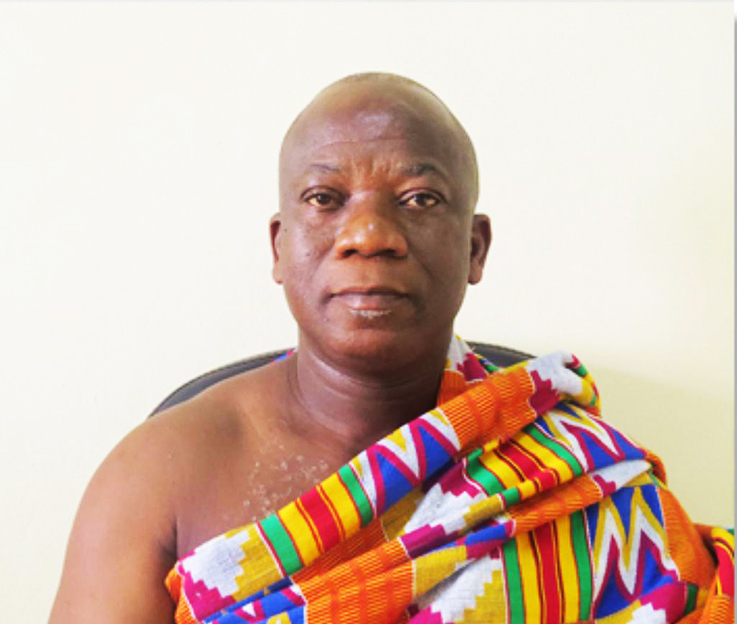
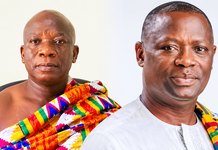
Omanheme of Eastern Nzema Traditional Area and President of Eastern Nzema Traditional Council, Awulae Amihere Kpanyinle III
“The office of a Paramount Chief is not created by a Member of Parliament, a District Chief Executive, a Regional Minister or a Cabinet Minister. Political constituencies are administrative and electoral arrangements established by the modern State. Traditional institutions have their own history, customary authority and constitutional protection. Hon.Emmanuel Armah-Kofi Buah is constitutionally entitled to represent the people who fall within his constituency.But that does not make him the traditional authority over the people. His position as MP does not confer upon him the power to determine who is Omanhene. His position as Minister for Lands and Natural Resources does not confer that power either. And no political office should be used, directly or indirectly, to create the impression that it does. That distinction is fundamental” he emphasized.
The Omanhene further revealed that one of the incidents that nails Hon. Armah Buah in this whole controversy which generated concern is his appearance on a public banner of last year Kundum alongside the self styled Omanhene.
He argued that ordinarily, a politician appearing on a banner at a public event might seem insignificant but context matters adding that where there is an unresolved dispute over traditional legitimacy, the public appearance of a senior Cabinet Minister alongside one claimant can reasonably be interpreted as an act of recognition or political endorsement.
“The matter becomes even more serious because, lawyers acting for me had already written to the Minister and cautioned him concerning his involvement in the matter especially when his photograph was featured on a banner as special guest of honor for the 2025 Kundum. The warning was therefore not absent. The Minister had allegedly been placed on notice, yet the conduct continued.
That raises a simple question: What did the Minister understand the lawyers’ warning to mean, and why did he nevertheless proceed in a manner capable of being interpreted as support for the disputed claimant?”, Awulae Kpanyinri stressed.
The Omanhene argued that the Minister’s participation in the 2025 Atuabo Kundum celebrations, despite the earlier caution from lawyers, was understood as demonstrating support for another person as Omanhene stressing that If that interpretation is wrong, the Minister has an opportunity to explain.
“If it is correct, then the conduct raises a much more fundamental concern about the use of political office in a chieftaincy dispute. A cultural festival must not be transformed into a political instrument for conferring legitimacy.
…The 2025 Atuabo Kundum celebrations brought the matter into sharper focus. Kundum is not merely another social gathering. It is an important cultural institution among the Nzema and Ahanta peoples, associated with harvest, thanksgiving and traditional identity and hence should therefore be a source of unity.It should not become an arena in which political actors communicate recognition of one claimant over another”.
Hon. Armah Buah is again alleged to have introduced the self styled Omanhene to the National Chairman of the NDC Johnson Asiedu Nketiah during a Thank you tour as opposed to the legitimate Omanhene Awulae Amihere Kpanyinri III.
“Another incident that deserves public scrutiny is the alleged presentation of the disputed claimant as Omanhene during the NDC National Chairman’s thank-you tour. This is particularly significant because it allegedly involved a Member of Parliament and a District Chief Executive presenting the person to a senior national political official in the capacity of Omanhene. That is not a minor detail. If the status of the individual remains disputed, presenting him to a national political figure as though the matter were settled creates a powerful public impression.
It can cause an ordinary political gathering to look like an official act of traditional recognition. It can also lead people who are unfamiliar with the history of the dispute to conclude that the State and governing political establishment have already chosen a side.
The questions are unavoidable:
Was the National Chairman informed that the person’s claim was disputed?
Was the recognised and gazetted Omanhene consulted?
Why was the disputed claimant presented as Omanhene?
Was the presentation made in a personal political capacity or in a manner that represented the position of Government?
And most importantly:
Who authorised the presentation?
These are legitimate questions of public accountability.
Political interference does not always take the form of a formal letter. Sometimes it happens through photographs. Sometimes through banners. Sometimes through who is invited to an official meeting. Sometimes through who receives a government delegation. Sometimes through who is introduced to a national political leader. Sometimes through who is excluded. And sometimes through the silence of public officials when a disputed narrative is repeatedly presented as fact. When these things happen repeatedly, they can gradually create a new public reality. The danger is that an unresolved traditional claim may eventually appear settled simply because powerful people have repeatedly behaved as though it were settled. That is not how chieftaincy legitimacy should be determined” he said.
The Awulae later recounted and Assassination attempt on him in his palace by Hirelings of the rival claimant, Berenger Aka Flanton, aka Awulae Blay who with the tacit support of Armah Buah is holding himself as Omanhene with the name and being given police protection in the palace even though he has not been gazetted and restrained by a court injunction.
THE PALACE AND THE SECURITY QUESTION
According to the Omanhene an assassination attempt was made on his life in early 2025 and that the resulting security concerns contributed to his temporary absence from his palace.
“That absence, he maintains, was not an abandonment of his traditional office. Rather, it was a security-related necessity. State security considerations subsequently created circumstances in which another person occupied the palace. That development must not automatically be interpreted as a determination of traditional legitimacy. A chief temporarily leaving a palace because of security concerns is one matter. Determining who lawfully occupies the stool is another. The two must never be confused. This is where the conduct of the Regional Minister and District Chief Executive also deserves scrutiny. The Regional Minister chairs the Regional Security Council, while the DCE chairs the District Security Council. Their primary responsibility is peace, security and public order not the determination of traditional legitimacy. If security arrangements have resulted in circumstances that appear to benefit one claimant to the detriment of another, the responsible authorities owe the public an explanation. Security must not become a mechanism for creating facts on the ground in a chieftaincy dispute”, the Omanhene emphasized.
THE ADAMUS QUESTION
Awulae Kpanyiri III also took a swipe at the Ellembelle Member of Parliament over his engagement with the self styled chief instead of he (Awulae Amihere Kpanyinri III.
“The Adamus mining controversy presents another important dimension. The Minister for Lands and Natural Resources has a legitimate governmental responsibility for mining and natural resources. Public reporting confirms his involvement in the Government’s handling of the Adamus mining leases and his engagement with Nzema traditional authorities concerning the future of the mine. There is nothing inherently improper about a Lands Minister discussing mining with traditional authorities.
The issue is which traditional authority is being engaged and on what basis.
If matters involving mining operations, land, compensation, community development and natural resources within Eastern Nzema are discussed with a person whose claim to the paramountcy is disputed, while the recognised and gazetted Omanhene is bypassed, then the public is entitled to ask why. The question becomes even more important because the Minister’s office carries substantial authority over land and mineral resources. Engagement with a disputed claimant in that context can create the impression that Government recognises that person as the traditional authority. That perception must be avoided. Government must be able to distinguish between consulting communities and recognising a claimant as Paramount Chief”, Awulae emphasized.
THE PRESIDENCY HAS BEEN INFORMED
The Omanhene indicated that steps have already been taken to bring these concerns to the attention of the Office of the President adding that that is an appropriate institutional route.
“The issue should not be resolved through political confrontation. It should be addressed through accountability, documentation and the proper constitutional institutions”, he indicated.
The Omanhene therefore urged the Presidency should to establish what government officials have done, what instructions they have received, what security decisions have been made, who has been officially recognised, and whether any public official has exceeded his or her lawful mandate in Eastern Nzema.
THE FINAL MESSAGE
“The MP represents his constituents.The Minister serves the Republic.The Regional Minister administers the region and chairs REGSEC.The DCE represents central government at the district level and chairs DISEC.The Omanhene serves the traditional institution and people of Eastern Nzema. Those roles are different.They must remain different.Political office cannot confer traditional legitimacy. Security office cannot confer traditional legitimacy. Government proximity cannot confer traditional legitimacy. Only the appropriate customary, constitutional and judicial processes can settle a disputed question of chieftaincy. That is the line that must not be crossed”, emphasized the Omanhene of Eastern Nzema and President of Eastern Nzema Traditional Council Awulae Amihere Kpanyinri.