






















Op-Ed By Fuvi Kloku
Following the intense 0-0 stalemate between Ghana and England at Boston Stadium on June 23, 2026, England captain Harry Kane stood before the cameras and offered an assessment that exposed far more than just post-match frustration.
When asked about the Black Stars’ resilient defensive performance, Kane remarked:
“Yeah, I think whenever you come against these type of nations where they’re, uh, just looking for kind of, uh, a nil-nil like they did today, they’re looking to waste a bit of time and win fouls. And, uh, from our point of view, I think we handled that pretty well.”
To the uncritical ear, this might sound like standard footballing grievance from a stymied striker. But language is rarely neutral. In a few brief sentences, Kane managed to evoke a deeply rooted Eurocentric superiority complex, leaning on a paternalistic lexicon that has historically been used to diminish non-Western sports teams.
We must ask the uncomfortable, necessary question: What exactly does Harry Kane mean by “these type of nations”?
The Subtext of “These Type of Nations”
When Kane collapses an entire sovereign country and a proud footballing culture into the reductive category of “these type of nations,” he isn’t just criticizing a 5-4-1 formation.
He is drawing a psychological boundary between the supposedly “civilized,” proactive football of Western Europe and the “primitive,” reactive anti-football of the Global South.
This is not a new phenomenon; it is a textbook manifestation of implicit racial and structural bias. In this worldview, Western European teams are viewed as default protagonists who possess the inherent right to play, dominate, and score at will.
When an African team refuses to play the role of the submissive lamb and instead deploys a highly disciplined, tactically sound defensive blueprint, the narrative is instantly warped. It is no longer praised as a masterclass; it is dismissed as cheap obstructionism, time-wasting, and trickery.
The Hypocrisy of the Tactical Double Standard
The intellectual dishonesty in Kane’s critique lies in the glaring double standard applied to football tactics. When a European team employs a low block, the global media and football elite fawn over their tactical sophistication.
– Chelsea vs. Barcelona (2012): When Roberto Di Matteo’s Chelsea famously “parked the bus” at the Camp Nou to eliminate a peak Barcelona, they were heralded as gladiatorial heroes who exhibited immense tactical discipline and mental fortitude.
– Inter Milan vs. Barcelona (2010): José Mourinho’s masterclass in defensive resilience is studied in coaching courses as a pinnacle of elite pragmatism.
– Atlético Madrid: Diego Simeone has built an entire, multi-million dollar legacy on the exact same principles of disrupting rhythm, narrowing spaces, and drawing fouls.
Yet, when Carlos Queiroz organizes the Ghanaian national team into a compact, impenetrable defensive unit that restricts a star-studded England attack to a historic failure, failing to score despite holding an extraordinary 78.8% possession, it is suddenly labeled an inherent flaw of “these type of nations.”
Furthermore, historical amnesia seems to have gripped the England captain.
The Three Lions themselves have played out tedious 0-0 group-stage stalemates in four of their last five major tournaments, including uninspired draws against Algeria in 2010, Costa Rica in 2014, and the United States in 2022. Is England, then, also one of those nations?
The Myth of the “Nil-Nil” Ambition
Kane’s assertion that Ghana arrived in Boston “just looking for a nil-nil” is not only patronizing, but factually incorrect. It completely erases the reality of the match. Ghana’s defensive posture was the foundation for a lethal counter-attacking strategy.
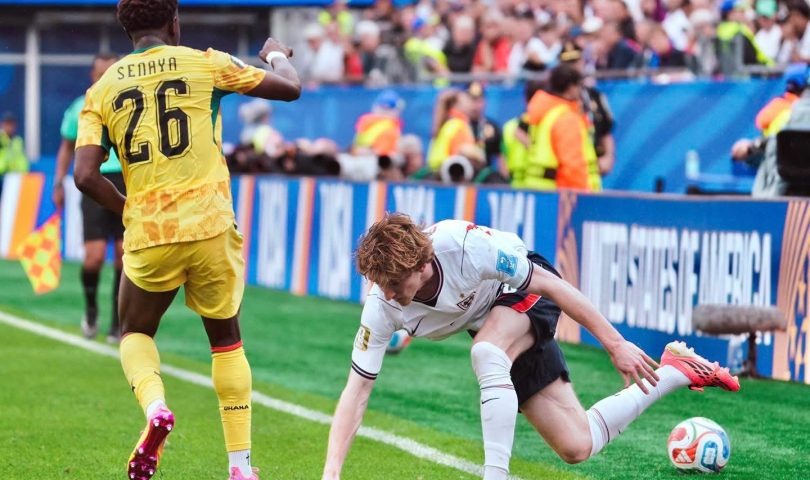
The turning point of the contest arrived when Prince Adu brilliantly burst past England’s high defensive line, threatening to break the deadlock.
As he bore down on goal, he was heavily challenged from behind by England’s Ezri Konsa. In any objective arena, free from the subconscious bias that dictates African teams are “looking to win fouls,” that moment warrants a definitive penalty and a potential red card for denying a clear goalscoring opportunity.
Had the match officials applied the rules without bias, the Black Stars could have easily walked away from Boston with a historic 1-0 victory.
To frame Ghana’s performance as purely negative is to gaslight an audience that watched the Black Stars match England’s physicality and tactical intelligence blow-for-blow.
A Lesson in Humility
Harry Kane’s comments reveal an underlying assumption that his side was entitled to a multi-goal victory simply by virtue of who they were playing. The frustration of skinnering a late rebound high into the Massachusetts sky seems to have clouded his judgment, leading him to blame the opposition’s “nationhood” rather than his own profligacy.
The 2026 FIFA World Cup is a global stage, and African nations are no longer here to merely make up the numbers or serve as aesthetic backdrops for European glory. Ghana gave England a masterclass in defensive resilience, structural discipline, and emotional composure.
Come again, Harry Kane. Before you categorize a nation, remember that football is a universal language, and on June 23, Ghana’s tactics spoke just as loudly as your star-studded lineup.
Turn your gaze inward, respect your peers, and understand that “these type of nations” are fully equipped to dismantle Eurocentric entitlement on any pitch in the world.