





















NPP GERMANY
PRESS RELEASE
07—10—2025
On Dormaahene’s Political Masks And His Juicy Reward For Propaganda—NPP GERMANY
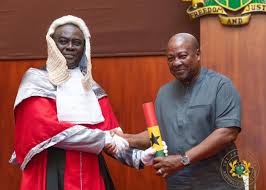
In Ghana’s turbulent political landscape, the recent appointment of the Dormaahene, Osagyefo Oseadeeyo Agyeman Badu II, to the Court of Appeal by President John Mahama has stirred serious questions about impartiality, political loyalty, and the erosion of public trust in the judiciary.
While traditional leaders are expected to maintain neutrality in partisan politics, the Dormaahene’s recent trajectory suggests a troubling departure from this sacred responsibility.
For years, the Dormaahene has not shied away from using public platforms to attack the past Akufo-Addo-led NPP government, often cloaking his political rhetoric in the garments of “truth-telling.”
His persistent criticism of the government — sometimes extending beyond constructive civic commentary — created the impression of a man deeply aligned with the opposition National Democratic Congress (NDC).
Now, his elevation to the Court of Appeal under an NDC administration appears less like a coincidence and more like a reward for partisan loyalty.
This development raises legitimate concerns about the independence of the judiciary and the moral weight of traditional leadership.
Can a figure who has so visibly aligned with one political camp command confidence as a judge?
The optics alone are damaging — both for the judicial service and for chieftaincy as an institution that should unify, not divide, society.
Critics argue that the Dormaahene’s appointment is not only a political favor but also a strategic move by President Mahama to consolidate influence within key state institutions ahead of the 2028 elections.
If true, this undermines the spirit of meritocracy and fairness that must underpin judicial appointments. Ghana’s democracy depends on leaders who can rise above partisan rewards and prioritize competence, integrity, and neutrality.
It is not wrong for traditional leaders to express opinions on governance — they are, after all, custodians of their people’s welfare. But when criticism turns into consistent partisanship, it compromises the moral authority of the stool and the throne.
The Dormaahene’s new judicial appointment, therefore, should not just spark applause; it should prompt sober reflection about where Ghana is heading as a democracy.
The line between service to the nation and service to a party must remain clear. When that line is blurred, even noble titles and judicial robes cannot conceal the stain of political opportunism.
While every Ghanaian citizen has the right to participate in governance, the Dormaahene’s long history of politically charged commentary—often perceived as partisan and critical of the New Patriotic Party (NPP) administration—raises legitimate concerns about the blurred lines between traditional authority and partisan politics.
Over the years, the Dormaahene has been one of the most outspoken chiefs in Ghana, often making pronouncements that align closely with the rhetoric of the opposition National Democratic Congress (NDC).
His consistent criticism of the Akufo-Addo-led government and defense of certain NDC policies have earned him a reputation as a political voice rather than a neutral traditional authority.
Now, with his appointment to a higher judicial office under the same political tradition he’s been accused of favoring, many Ghanaians perceive this as a reward for partisan loyalty rather than merit—a development that casts a shadow over the credibility of both traditional leadership and the justice system.
This incident highlights a larger national concern: the creeping politicization of Ghana’s chieftaincy institution. Traditional leaders occupy a sacred place in the country’s governance structure.
They are supposed to be symbols of unity, custodians of culture, and mediators of peace—not political actors. When chiefs openly campaign, make partisan comments, or accept political appointments perceived as rewards, they risk eroding the public trust that gives their stool or skin legitimacy.
Ghana’s democracy thrives on the separation of powers and the integrity of its institutions. If traditional authorities—who wield immense moral and social influence—become partisan, they risk dividing their people along political lines.
In communities where chiefs are seen as fathers of all, their political bias can alienate subjects who belong to different parties, undermining cohesion and respect for the stool itself.
This is not to say that traditional leaders should be silent on national issues. On the contrary, their voices are important in national discourse.
But there is a clear difference between constructive national advocacy and overt partisan propaganda. Chiefs must use their platforms to promote unity, development, accountability, and social harmony—not to advance political agendas.
The Dormaahene’s situation should serve as a cautionary tale. Political favoritism may bring short-term gains, but it ultimately weakens the moral authority of traditional leadership.
The chieftaincy institution, one of the few remaining cultural pillars in modern governance, must remain above political influence if it is to retain its dignity and respect in the eyes of the people.
Going forward, Ghana needs to have an honest conversation about the boundaries of political engagement for traditional rulers.
The National House of Chiefs, as the custodian of the institution, must enforce a code of conduct that clearly separates chieftaincy from partisan politics.
Without such safeguards, traditional authority risks being reduced to another pawn in the political chess game—something our democracy can ill afford.
History will not forgive cowardice.
And Ghanaians must not tolerate betrayal.
Ghana’s democracy deserves better.
God Bless Our Homeland Ghana!!!
Long Live Ghana, long live the Elephant Party!!!!
Kukruduuuu Eeeessshiii!!!
Signed:
Nana Osei Boateng
NPP GERMANY
Communications Director