

















NPP GERMANY Branch in its series of online health awareness campaign last week Sunday focused on the growing dangers of stroke and the impact of stress on cardiovascular health.
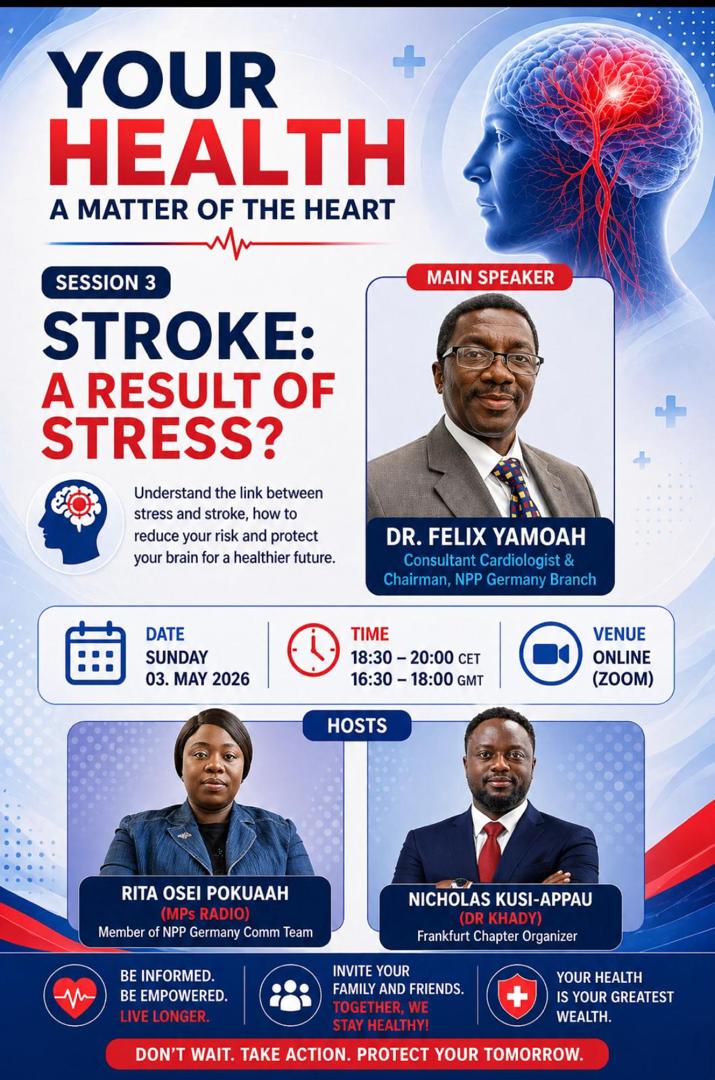
The event, which was on the theme “Stroke: A Result of Stress?”, formed part of the “Your Health: A Matter of the Heart” educational series aimed at promoting public awareness on heart and brain health.
The virtual session was held on Sunday, May 3, 2026, via Zoom and attracted health-conscious participants, professionals, political activists, community members and members of the Ghanaian diaspora community in Germany and beyond.
The webinar featured renowned cardiologist Dr. Felix Yamoah, Consultant Cardiologist and Chairman of the NPP Germany Branch, as the main speaker for the session.
The programme was hosted by Rita Osei Pokuah of MPs Radio, a member of the NPP Germany Communications Team, together with Nicholas Kusi-Appau (Dr Khady), Frankfurt Chapter Organizer.
Throughout the session, participants were educated on the relationship between chronic stress and stroke, as well as practical ways individuals can reduce their risk factors through lifestyle changes and regular medical care.
Opening the discussion, Rita Osei Pokuah described the programme as a necessary public education initiative aimed at saving lives through information and awareness.
According to her, many people ignore early warning signs of stroke because they lack adequate knowledge about the condition and its triggers.
“Health education remains one of the strongest tools for prevention. We want people to understand that protecting their health must become a daily priority,” Rita Osei Pokuah stated.
Dr. Felix Yamoah, during his detailed presentation, emphasized that stroke remains a medical emergency that requires immediate intervention.
“Every minute matters during a stroke episode because brain cells begin to die within minutes. Time saved is truly brain saved,” Dr. Yamoah stressed.
He explained that there are two major forms of stroke — ischemic stroke, which is caused by blood clots and accounts for the majority of stroke cases, and hemorrhagic stroke, which results from burst blood vessels in the brain.
According to him, both types demand urgent medical attention and should never be underestimated.
Dr. Yamoah further explained that although stress may not directly cause stroke in every case, chronic stress significantly increases the risk through elevated blood pressure, inflammation and increased clotting tendencies.
“Stress is a real risk multiplier. When stress becomes chronic, it affects blood pressure, sleep, emotional stability and the overall cardiovascular system,” he said.
The cardiologist also disclosed that a large percentage of stroke cases can actually be prevented when people adopt healthier lifestyles and seek regular medical reviews.
“Up to 80 percent of strokes are preventable through proper lifestyle management, blood pressure control, exercise, healthy diet and consistent medical checkups,” Dr. Yamoah noted.
Participants were also educated on the internationally recognized FAST warning signs used in identifying stroke symptoms quickly.
The acronym FAST refers to Face drooping, Arm weakness, Speech difficulty and Time to seek emergency assistance immediately.
Dr. Yamoah encouraged participants to memorize the warning signs and educate family members and close friends in order to improve emergency response and survival rates.
The session additionally focused on practical action plans individuals can implement immediately to reduce their risk of stroke and other cardiovascular diseases.
Participants were advised to regularly monitor their blood pressure levels, maintain healthy eating habits, reduce processed foods and salt intake, and establish consistent sleeping routines.
The health education programme also encouraged individuals to engage in moderate physical exercise for at least 30 minutes daily over five days each week.
Mental health and emotional wellness were equally highlighted as essential components of stroke prevention and long-term cardiovascular health.
Speakers advised participants to practice stress management techniques including prayer, mindfulness, relaxation, spending time in nature and maintaining healthy social relationships.
The discussion also touched on the dangers of smoking, vaping and alcohol abuse, with medical experts strongly encouraging participants to seek support where necessary to overcome harmful habits.
Organizers of the programme described the event as part of a broader commitment toward community health advocacy and preventive medical education among Ghanaians both home and abroad.
They noted that increasing awareness on stroke prevention has become more important in recent years due to growing lifestyle-related health complications globally.
Participants who joined the webinar praised the organizers for delivering practical and easy-to-understand health education capable of helping families make better health decisions.
The event ended with a strong call for individuals to take their health seriously, seek regular medical screening and prioritize preventive healthcare before complications arise.
“Your health is your greatest wealth. Be informed, be empowered and live longer,” Rita Osei Pokuah concluded during the closing remarks of the webinar.
Signed:
Nana Osei Boateng
NPP GERMANY Branch
Communications Director