


















Author: Daniel Nii Okine
ADIDOME, VOLTA REGION — To those sitting in offices in Accra, or living far outside the Central Tongu District, the Atsiteto and Klamandor Boundary road may sound like just another stretch of transit on a map.
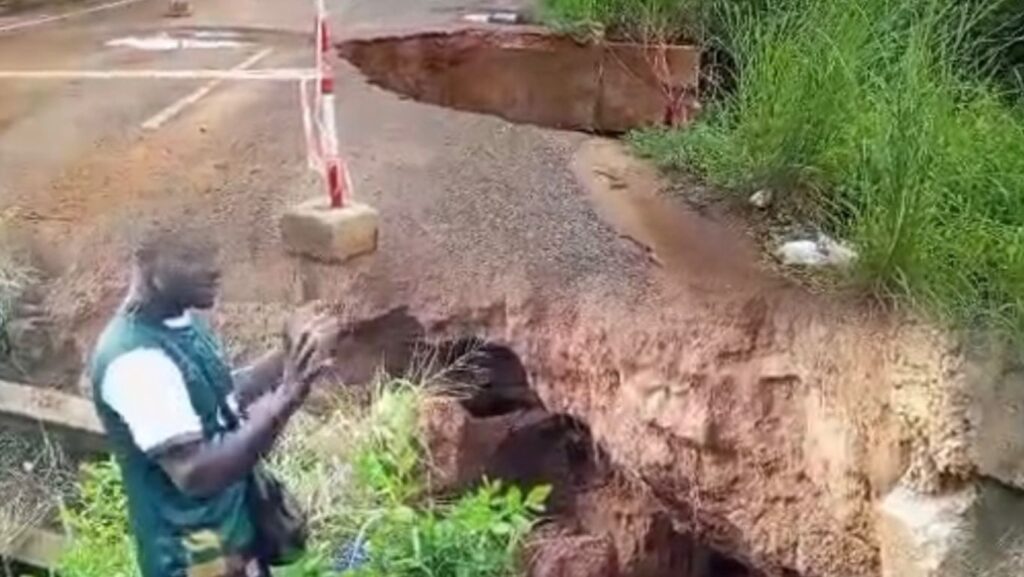
On the ground, however, it has become the site of an active, unfolding infrastructure disaster. An on-site inspection of the corridor reveals a worsening structural failure that has advanced far beyond routine potholes.
Driven by relentless rain and an unceasing barrage of heavily loaded cargo trucks, this bitumen surfaced gravel road, is literally washing away, forcing thousands of commuters into a deadly bottleneck. Anyone with human sympathy, and even a basic understanding of public safety, can see how serious and dangerous this situation has become. It is no longer a matter of if a catastrophic collapse will occur, but when.
A Year of Official Neglect
While the entire corridor is compromised, amateur reporter Alhajie Samuel Goku has highlighted the epicenter of the crisis on video: the volatile boundary stretch between Atsiteto and Klamandor. According to Goku’s frontline reports, this “death trap” did not appear overnight. The structural decay began during last year’s rainy season, yet despite clear warning signs, it was met with total institutional silence.
No one paid attention. In a striking irony of local governance, it is widely alleged that the area’s District Chief Executive (DCE) and local assembly members walk and drive past this crumbling boundary regularly, literally stepping over a brewing disaster without taking action. The gravity of the neglect is further underscored by proximity: the residence of the former Member of Parliament and former Minister of Roads and Highways, Hon. Joe Gidisu, sits close to the heavily affected area.
The Anatomy of a Collapse: From Pothole to Gaping Void
Because this road consists of a gravel base covered only by a thin layer of bitumen, rather than solid asphalt, it is highly vulnerable to moisture. What began as a localized surface defect at the Atsiteto, Klamandor stretch has escalated into an existential threat to the entire corridor.
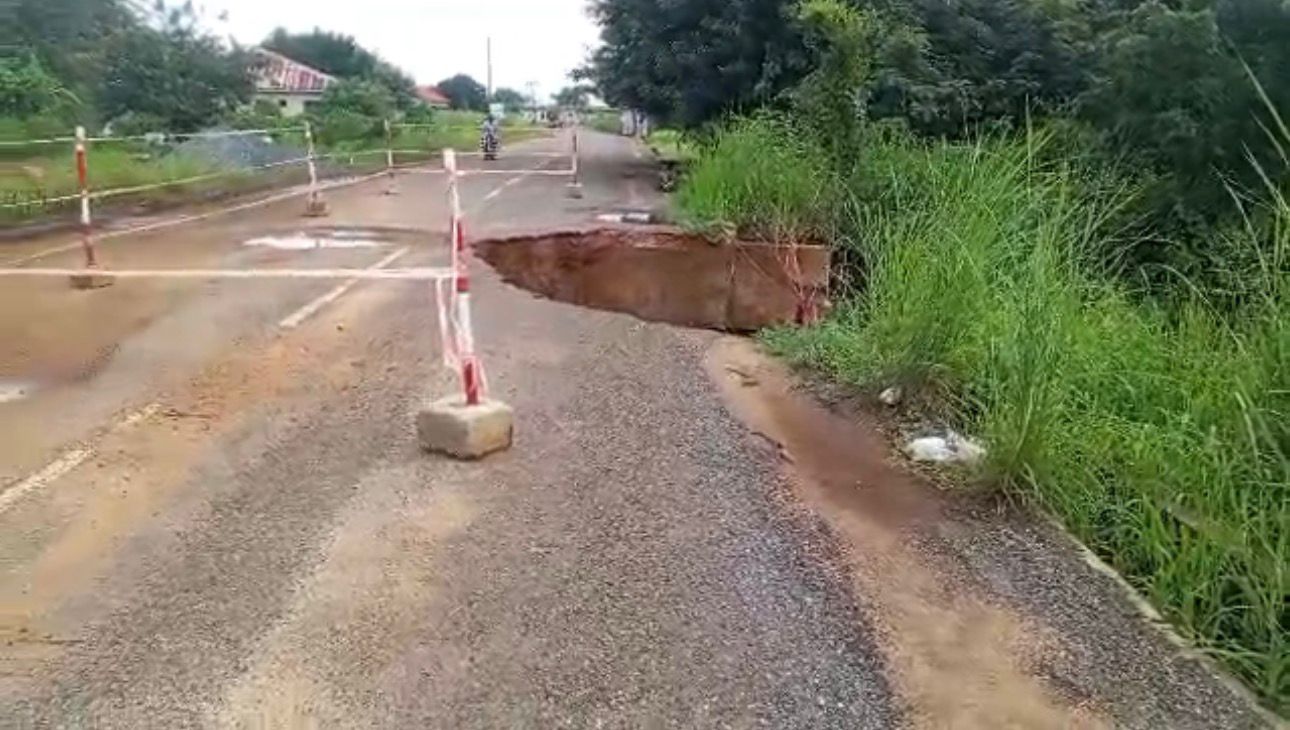
A massive erosion gulley has eaten deep into the shoulder, causing the roadside to fall away. With every downpour, the underlying gravel saturates, liquefies, and flushes out, allowing the damage to creep aggressively into the active driving lanes. The physical reality is alarming:
The Disappearing Carriageway: The failure has expanded so deeply into the roadbed that the original caution tape and protective perimeter have been forced backward.
The Quarter Road Bottleneck: To prevent vehicles from plunging into the abyss, especially at night, the protective rope has been pushed to the center line. As a result, traffic now moves on barely a quarter of the full road width.
24 Hour Battering by Heavy Freight
This extreme narrowing would be a logistical nightmare under normal traffic conditions. But the Atsiteto, Klamandor stretch is a vital economic artery, subjected to a brutal, 24 hour cycle of heavy freight movement that the fragile bitumen, on gravel surface was never designed to withstand. Day and night, the road is pounded by high-tonnage vehicles:
Articulated trucks loaded with hundreds of bags of cement.
Fleets of 12 tanker fuel trucks carrying thousands of liters of inflammable liquids.
Tippers transporting heavy river sand, often moving in aggressive packs of five or six fully laden trucks. Because traffic has been forced into a single narrow strip, the entire weight of these convoys is concentrated on the same few square meters of fragile road. The resulting pressure and violent vibrations are shattering what little binding the bitumen provided, pulverizing the gravel foundation beneath.
Structural Failure: Exposed Iron Rods and Sinking Bridges
This is no longer a surface-level problem that can be patched. The deep structural skeleton of the road is failing.
“The concentrated, continuous pressure and vibration are causing the convex and gutter to crack and break, iron rods and structural elements are becoming exposed.”
Multiple sections are actively sinking. At the bridge edges and raised convex areas, the concrete elements supporting the gravel roadbed are cracking open, exposing internal iron rebar to rain and traffic.
When steel reinforcement is exposed to moisture and repeatedly struck by 40 tonne trucks, structural fatigue accelerates rapidly. The approach to the bridge is beginning to shear away from the main structure.
The Digital Echo Chamber vs. Political Inertia
Frustrated by the lack of official response, citizens like Alhajie Samuel Goku have turned to digital whistleblowing. Videos documenting the hazard are circulating widely on TikTok and other platforms. But while the content spreads informally, generating reactions, shares, and even mocking commentary from a public weary of infrastructure failures, it has not stirred those in power.
“I’ve not heard anything, politicians carry big power”, Alhajie Samuel Goku said. A profound frustration is growing among residents. The prevailing sentiment points to a systemic, dismissive political mindset where officials choose to patronize, ignore, or push back against public concerns rather than address them. Social media exposure alone has proven insufficient; the message must reach the authorities who hold the power to act.
An Urgent Call to Action: Prevent the Inevitable
This is an open appeal to the Ministry of Roads and Highways, the Ghana Highway Authority (GHA), and local government leadership. If immediate emergency intervention is not deployed, the Volta Region risks a catastrophic structural failure that will sever a vital transit route, freeze local commerce, and inevitably claim innocent lives in a fatal plunge or head-on collision.
Immediate Interventions Required
Emergency Structural Stabilization: Deploy engineers to reinforce the eroding gravel slope at the Atsiteto, Klamandor boundary, seal exposed iron rebar, and halt sub-base failure at the bridge approach.
High Visibility Traffic Management: Replace flimsy caution ropes with weighted, retro-reflective water barriers and temporary solar-powered traffic lights to manage the one-way bottleneck safely.
Load Management and Enforcement: Temporarily regulate or divert the heaviest multi-axle freight convoys to prevent total collapse of the remaining quarter of the road.
The warnings are visible, the structural elements are exposed, and the ground is literally sinking. Authorities must act now, before this becomes a story of preventable tragedy.