















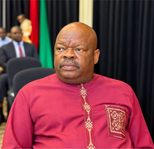







Author: Prof. Michael Kpessa-Whyte
The decision by the National Democratic Congress to name its national headquarters the Jerry John Rawlings House is more than an act of remembrance.
It is a profound statement of identity, gratitude, continuity, and unity. It is a symbolic return to the moral origins of a party whose birth was shaped not only by political organization, but also by a historic national demand for accountability, probity, justice, discipline, and social purpose.
Buildings are never neutral. They carry memory. They announce values. They teach generations what an institution considers sacred. To name the headquarters of the NDC after Flt. Lt. Jerry John Rawlings is therefore not merely to honour a founder.
It is to place before every party officer, government appointee, parliamentary candidate, branch executive, constituency organizer, and ordinary member a permanent reminder of the moral fire from which the party emerged.
That fire was Rawlings.
The significance of the occasion was captured most powerfully by President John Dramani Mahama, who described the day as one of remembrance, gratitude, and renewal. In doing so, he gave the event its proper meaning.
This was not simply a ceremony to rename a building or unveil a bust. It was an invitation to the NDC family to reflect on its journey, honour those whose sacrifices shaped its political tradition, and recommit itself to the ideals that gave the party life and moral authority.
That framing matters. Political memory is not useful when it becomes mere nostalgia. It is useful when it becomes a guide to conduct.
President Mahama was therefore right to insist that the ceremony was about preserving history, celebrating leadership, and passing enduring values to future generations.
His remarks gave the occasion both dignity and direction. They reminded the party that institutions endure not only because they have offices, constitutions, executives, and structures, but because they are animated by values larger than the ambitions of individuals.
Rawlings was not perfect, and no honest reading of history should pretend that he was. He was human, complex, forceful, controversial, charismatic, impatient with hypocrisy, and often uncompromising in his understanding of public duty. But the greatness of a historical figure is not measured by the absence of controversy.
It is measured by the depth of the questions he forced a nation to confront, the courage with which he spoke to the anxieties of ordinary people, and the enduring consequences of his actions.
By that measure, Jerry John Rawlings remains one of the most consequential figures in Ghana’s political history.
At a time when many Ghanaians felt abandoned by the state, mocked by privilege, and suffocated by corruption, Rawlings emerged as the voice of public anger.
He represented the cry of the market woman whose labour produced no dignity, the worker whose salary had been eroded by economic decay, the soldier whose uniform had become a symbol of sacrifice without reward, the youth whose future had been undermined by mismanagement, and the ordinary citizen who watched a privileged few behave as if Ghana belonged to them alone.
It is easy, from the comfort of the present, to speak of the Rawlings moment only in the language of military intervention. But that would be incomplete.
To understand Rawlings, one must understand the Ghana into which he erupted. It was a Ghana tired of excuses, wounded by economic decline, weakened by institutional decay, and angered by the normalization of impunity. Public office had, in too many cases, become a private harvest. Public resources had become objects of elite capture. The moral distance between rulers and the ruled had widened dangerously.
Rawlings did not invent the anger of the people. He gave it language. He did not manufacture national frustration. He embodied it. He did not create the demand for accountability. He dramatized it with such force that the political class could no longer ignore it.
This is why his memory still matters.
The courage of that young, frustrated military officer was not simply the courage of rebellion. It was the courage to insist that a country cannot survive when corruption becomes fashionable, when public officials become untouchable, when ordinary people are asked to sacrifice while the powerful loot without shame, and when governance loses its moral centre.
Rawlings insisted, sometimes in ways that unsettled the establishment, that leadership must be answerable to the people. He compelled Ghana to confront a simple but uncomfortable truth: democracy without accountability can easily become a ritual of elections without justice.
That is the deeper meaning of the Rawlings legacy.
It is also the meaning that the commemorative lecture sought to recover. The participation of Mr. Tsatsu Tsikata, Mr. Kofi Totobi Quakyi, and Dr. Akwasi Opong-Fosu gave the occasion a deeper historical texture. These were not casual observers of the Rawlings era. They are figures whose public lives intersected with the struggles, debates, transitions, tensions, and achievements that shaped the journey from revolution to constitutional rule.
Their presence and reflections helped remind the party that Rawlings’ legacy cannot be reduced to one man’s charisma. It is a legacy embedded in institutions, comradeship, sacrifice, political education, ideological contestation, and the difficult labour of state-building.
Mr. Tsatsu Tsikata’s warning that the NDC must never become complacent in office, but must constantly prove its relevance and value to the Ghanaian people, deserves particular attention. It is a statement that goes to the heart of the Rawlings tradition. The NDC was not founded to enjoy power for its own sake. It was not founded to become comfortable in office.
It was not founded to take the people for granted. It was founded to give political expression to the needs, frustrations, aspirations, and dignity of ordinary Ghanaians. Whenever the party forgets this, it weakens the very moral claim upon which its legitimacy rests.
The remarks associated with Mr. Kofi Totobi Quakyi and Dr. Akwasi Opong-Fosu also matter because they locate Rawlings within the long arc of political transformation. Mr. Totobi Quakyi represents a generation that lived the transition at close range and understood the burden of communicating, defending, and institutionalizing a movement born in turbulent times.
Dr. Opong-Fosu, through his public service and local governance experience, reminds us that Rawlings’ political project was not only about national command; it was also about bringing governance closer to the people, deepening participation, and making public authority meaningful in the everyday lives of citizens. Together, these voices help illuminate the theme of the commemoration: from revolution to the Fourth Republic.
Out of the turbulence of military revolution, Ghana found its way into one of Africa’s most enduring democratic experiments. This is the paradox that must be understood with maturity and honesty.
From the belly of revolution emerged the Fourth Republic. From a period of upheaval emerged a constitutional order that has endured for decades. From a movement initially defined by radical rupture emerged a party that would become one of the principal pillars of Ghana’s democratic stability.
History is not always born clean. Sometimes, nations are remade through contradictions. Ghana’s democratic journey under the Fourth Republic did not fall from the sky. It came through struggle, agitation, transition, negotiation, institutional reform, and political learning. Rawlings stood at the centre of that difficult transformation.
He moved from military ruler to elected president. He presided over the transition from revolutionary command to constitutional rule. He submitted himself to the discipline of electoral politics. And when his constitutional mandate ended, Ghana witnessed a peaceful transfer of power that strengthened the democratic culture of the Republic.
That moment remains one of the great achievements of Ghana’s political development.
It demonstrated that power, however deeply held, must finally bow to constitutional limits. It showed that a leader forged in revolution could still submit to the sovereignty of the people expressed through constitutional democracy.
It taught Ghana that strong leadership and democratic transition need not be enemies. It also established the NDC not merely as a party of power, but as a party tied to the survival and consolidation of the Fourth Republic.
For this reason, the name Jerry John Rawlings House must not be treated as a decorative honour. It must be treated as a moral command.
The NDC also deserves commendation for the manner in which this symbolic act has been handled. In naming the party office after Rawlings, the party has demonstrated unity not only in form, but also in substance. It has shown that political memory can be used to heal, to gather, and to strengthen collective identity.
At a time when political parties can easily be consumed by internal factions, generational tensions, and competing claims to legacy, this act reminds the NDC family that its history is larger than any individual ambition and deeper than any temporary disagreement.
This is why President Mahama’s role in the ceremony is especially important. As leader of the party and President of the Republic, his words carried both institutional and moral weight. His reminder that the headquarters is more than an administrative facility, that it is the operational heart of the party where ideas are debated, policies are formulated, strategies are developed, and programmes are shaped in service of Ghana, gives the building a living purpose. It is not merely a house of party administration. It must become a house of reflection, discipline, service, and renewal.
President Mahama was also right to observe that the honour done to Rawlings is not only a tribute to his contribution to the party and nation, but a declaration that the values he championed must continue to guide both party and government.
Integrity, patriotism, sacrifice, courage, discipline, service, accountability, and concern for ordinary people must not become ceremonial words spoken on anniversaries. They must become the operating principles of power.
That is why the naming of the national headquarters must radiate beyond Adabraka. Every NDC party office across the country, whether built or rented, whether modest or imposing, whether located at the branch, ward, constituency, or regional level, should be seen automatically as an annex of Jerry John Rawlings House. This does not require a formal inscription on every wall.
It requires a living commitment in every office. Wherever the NDC gathers to organize, deliberate, mobilize, educate, reconcile, or serve, that space must carry the values Rawlings stood for. Every party office must preach probity. Every branch office must preach accountability. Every constituency office must preach humility in service. Every regional office must preach discipline, unity, sacrifice, and commitment to the ordinary Ghanaian.
In that sense, Jerry John Rawlings House should not be understood only as a physical structure in Accra. It should become a national moral architecture for the party. Its meaning must travel to the grassroots.
Its values must be heard in branch meetings, constituency conferences, youth wings, women’s wing gatherings, regional executives’ deliberations, campaign platforms, and government appointments. If the headquarters carries the founder’s name, then every office of the party must carry the founder’s burden.
The NDC must never forget that Rawlings spoke for the majority of Ghanaians who felt excluded from the banquet of the nation. He spoke for those who had no lobbyist, no family name, no access to corridors of privilege, and no protection from the arrogance of power. His politics, at its deepest, was a politics of ordinary people. He understood instinctively that a party that loses touch with the ordinary citizen loses its soul long before it loses an election.
That is the lesson the NDC must never depart from.
The party was not founded to become a comfortable refuge for careerists. It was not founded to reproduce the very arrogance it once condemned. It was not founded to become a vehicle for entitlement, patronage, internal exclusion, or the casual misuse of public authority.
It was founded on a moral claim: that governance must serve the people, that leadership must be disciplined, that corruption must be confronted, that the poor must not be forgotten, and that national development must have a human face.
To enter Jerry John Rawlings House, therefore, must be to enter a space of memory and responsibility. It must remind party leaders that political power is not inheritance; it is trust. It must remind government appointees that public office is not decoration; it is service. It must remind parliamentarians that representation is not performance; it is duty. It must remind the youth of the party that politics is not only about ambition, but also about sacrifice, conviction, courage, and accountability.
The name should make every occupant of that building uncomfortable with corruption. It should make them restless in the face of inequality. It should make them impatient with excuses. It should make them allergic to arrogance. It should make them remember that the legitimacy of the NDC has always depended on its ability to speak to the lived realities of ordinary Ghanaians.
Rawlings understood something that remains vital today: people do not hate leadership; they hate betrayal. They do not resent authority; they resent impunity. They do not oppose government; they oppose government that forgets them. When the state becomes distant, when politicians become self-absorbed, when institutions become unresponsive, and when the poor are treated as spectators in their own republic, democracy becomes vulnerable to cynicism.
The Rawlings tradition, properly understood, is a warning against that decay.
It is also a call to renewal. The NDC must interpret the naming of its headquarters not as the closing ceremony of Rawlings’ memory, but as the beginning of a deeper internal recommitment. The party must ask itself difficult questions. Does it still speak with moral clarity on corruption?
Does it still defend the ordinary Ghanaian with conviction? Does it still treat grassroots members as the owners of the party rather than as instruments for election season? Does it still believe in discipline, sacrifice, and probity? Does it still have the courage to correct its own when power begins to breed arrogance?
These questions matter because Rawlings’ name cannot be separated from Rawlings’ values. To honour the man while abandoning the moral grammar of his politics would be an act of symbolic betrayal. A party headquarters bearing his name must not become a house of convenience. It must become a house of conscience.
There will always be debates about Rawlings. That is inevitable. Great historical figures invite debate because they leave behind legacies too large to be reduced to praise or condemnation. But even those who disagree with aspects of his methods cannot deny the force of his impact.
He changed Ghana’s political vocabulary. He made accountability a national expectation. He carried the language of probity into the centre of governance. He brought the frustrations of the ordinary citizen into the highest chambers of power. He reshaped the architecture of Ghanaian politics. And he became inseparable from the birth and consolidation of the Fourth Republic.
The NDC is right to honour him.
But honour must go beyond ceremony. It must go beyond busts, banners, speeches, and anniversary rituals. The highest honour the NDC can pay Jerry John Rawlings is not merely to place his name on a building, but to place his values at the centre of its conduct.
The party must remain close to the people. It must remain offended by corruption. It must remain committed to social justice. It must remain humble in power. It must remain bold in reform. It must remain disciplined in government. It must remain faithful to the moral majority for whom Rawlings spoke.
Jerry John Rawlings House must therefore stand as a covenant between memory and mission. It must tell the country that the NDC remembers where it came from. It must tell party members that the founder’s legacy is not a museum piece. It must tell appointees that public service is a solemn obligation. It must tell the youth that courage matters. It must tell the ordinary Ghanaian that the party still hears them.
For Rawlings’ politics, at its most powerful, was never merely about Rawlings. It was about the people. It was about the stubborn belief that Ghana must not be surrendered to greed, arrogance, and indiscipline. It was about the conviction that the poor deserve dignity, that the powerful must be accountable, and that leadership must be judged by its service to the nation.
That is why the name matters.
Jerry John Rawlings House is not just a headquarters. It is a reminder. It is a warning. It is a promise. It is a call to return to the moral foundations of a movement that helped carry Ghana from revolution into constitutional democracy.
And if our party, the NDC, remains faithful to that call, then the name on the building will not merely honour the dead. It will guide the living. More importantly, it will ensure that from the national headquarters in Accra to the smallest branch office in the country, every NDC space becomes a living annex of the Rawlings tradition: a house of service, accountability, unity, sacrifice, courage, and fidelity to the ordinary people of Ghana.